


Township Retail Signage in South Africa: A Practical Guide
Township retail signage in South Africa is one of the most underpriced opportunities in the local market. Millions of shoppers buy groceries, airtime, hair products and cold drinks from shops whose fascias were never designed to sell anything. The brands that take the high street seriously often win the corner before competitors notice. The South African digital signage market is growing faster than the global average, but growth on the high street depends on something simpler: a sign a passing customer can read in a second and trust enough to walk through the door. This guide covers how to design, light, mount and roll out signage that reaches high-growth audiences without wasting budget.
Table of Contents
- Quick Takeaways
- Why Township Retail Needs Its Own Signage Playbook
- Reading Foot Traffic on a Township High Street
- Language, Colour and Legibility at Shopfront Distance
- Sign Types Compared for Small Township Shops
- Power, Weather and Durability in Real Conditions
- Rental and Pop-Up Options for Seasonal Retail
- Franchise Rollouts and Keeping Brand Standards Intact
- Measuring Whether a Sign Is Working
- Frequently Asked Questions
- References
Quick Takeaways
| Key Insight | Explanation |
|---|---|
| Legibility beats decoration | A passing shopper gives a sign a second or two. Put the trading name and the product category in the largest type, and cut everything else. |
| Walk the route before you design | Spend an hour watching where people slow, cross and queue. Mount the sign where the approach from the main direction of travel meets the shopfront. |
| Name the category, not just the brand | Many township purchases are top-ups such as airtime, bread or cold drinks. Words that name the product pull a shopper in from the pavement. |
| Plan for power cuts | An LED sign that goes dark when the grid drops costs you evening trade. Choose low-draw modules and consider battery backup for shops that trade after dark. |
| Rent for pop-ups and seasonal peaks | Short-term locations rarely justify a permanent build. Rental lets you test a location before you commit capital to it. |
| Standardise the spec, localise the message | Franchise networks should fix colours, fixings and logo placement, then allow one local line for language and product focus. |
Why Township Retail Needs Its Own Signage Playbook
Most corporate sign packages were designed for shopping centres and retail parks, where customers arrive by car, stop briefly and read signs from a distance. Township high streets run on different rules. Shoppers arrive on foot, by minibus taxi and by bakkie, often in groups, and they make most decisions from the pavement.
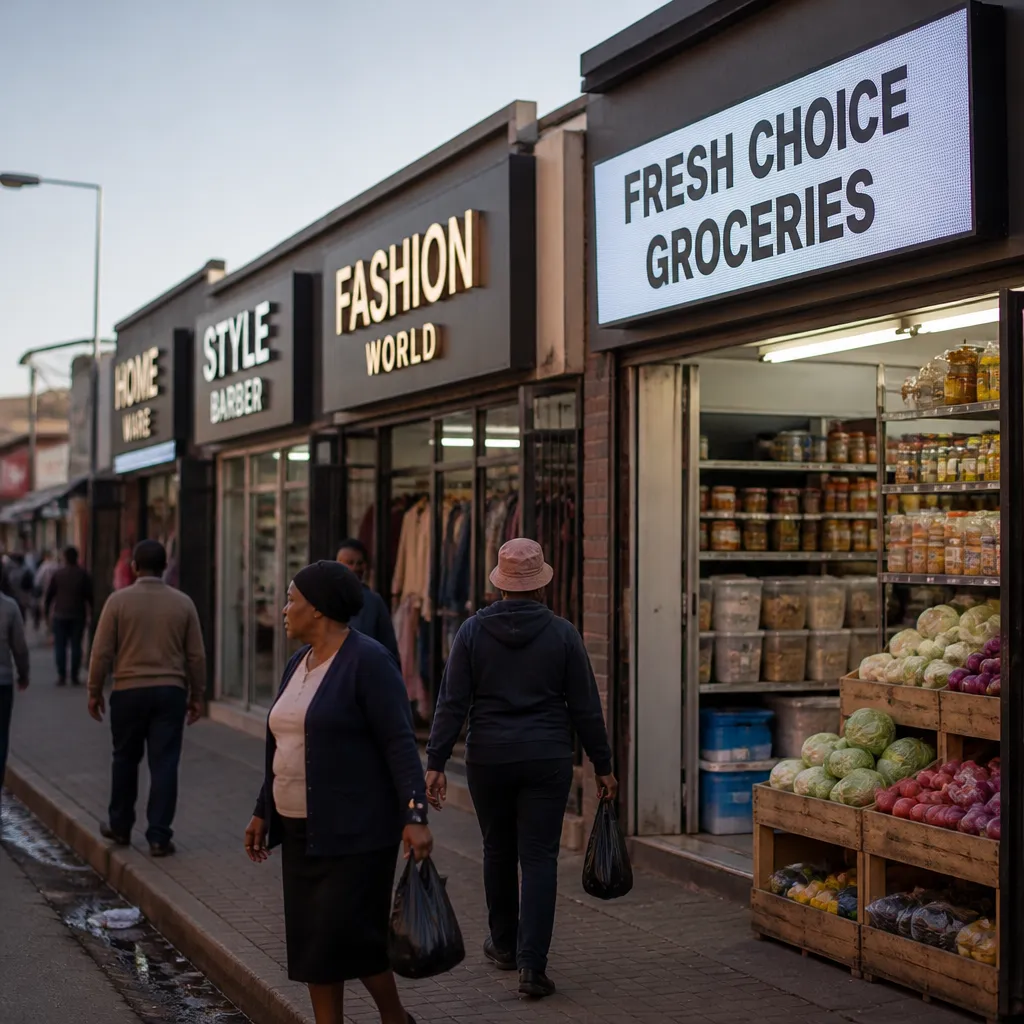
The market case is real. MarketsandMarkets forecasts that South Africa's digital signage market will grow at about 8% a year from 2026 to 2031, ahead of the global rate of 6.6%, with retail among the main drivers. For a shop owner or franchise operator, that growth means more businesses competing for the same attention, not a guaranteed audience.
Growth is arriving faster than the signage on the street
In practice, many emerging-market shops still run on hand-painted boards, faded vinyl or a fascia that has not changed since the day the shop opened. That gap is the opportunity. A clean, legible sign in a street of tired ones gets noticed, and in a crowded market, being noticed is most of the battle.
A common mistake is copying a suburban mall design into a township context. Thin fonts, pale grey backgrounds and a logo that needs a magnifying glass may look premium in a showroom, but they disappear at the taxi rank.
Brand standards still matter, but the sign must earn its place
Corporate and franchise clients often ask us to keep the full brand system intact at every location. We agree, but the brand has to be readable first. Keep the logo, colour palette and typeface, then adapt the layout so the trading name and product category are instantly clear. A sign that protects the brand but fails the customer protects nothing.
Reading Foot Traffic on a Township High Street
Before you draw a single sign, walk the route at the hours your customers actually buy. Note where people slow down, where they cross, and where they queue. The sign belongs where a shopper's eye lands as they approach from their usual direction, not where it looks best on an architect's elevation.
Where the eye lands first
Corner shops are seen from two directions, so the message has to work from both. A sign that reads well only from the bus stop side wastes half its exposure. Test each approach by walking towards the shop and noting the exact point where the trading name becomes readable.
Pro tip: Photograph the street from the point where a shopper first sees your frontage, then mock up the sign on that photo. If the headline is not readable in the mockup, it will not be readable in person.
Designing for the walk-past shopper
Many township purchases are quick, unplanned top-ups: bread, airtime, data, a phone charger or a cold drink. A sign that shows only a brand name tells a passing shopper nothing about what is inside. Pair the trading name with two or three category words that match what people buy at the counter.
Current retail signage trends lean heavily on directional cues such as clear arrows and floor graphics that guide customers naturally. On a township street, the equivalent is a simple arrow pointing to the entrance or till, especially where the door is set back from the pavement and a shopper might walk straight past it.
Language, Colour and Legibility at Shopfront Distance
Language is the first decision most providers get wrong, usually by guessing. Do not assume the language mix from the outside of the shop. Ask the owner which languages customers use at the counter, and watch what people actually say when they buy. A bilingual sign works when the trading name stays on one line and the category uses the words customers use themselves.
Contrast, font and size that survive the street
Good sign design prioritises clarity and readability above everything else, a principle that appears in most in-store signage best practice guides. In a township setting, that means dark text on a light ground, or white on a strong, deep colour, with a plain sans-serif typeface. Avoid script fonts and thin strokes, which lose their shape at a distance and in harsh midday sun.
Keep the headline to a few words. Dekkers' retail signage guidance makes the same point in its own way: signs with too much information fail, because the viewer gives up before finding the message. One headline, one supporting line and one call to action is enough for most shopfronts.
Colour as a signal, not decoration
Colour should tell the shopper what kind of shop this is before they read a word. Pick a dominant colour that stands out against the surrounding fascias on that particular street, not one that matches a corporate palette on a brochure. Then test the sign from the pavement at different times of day, because strong afternoon light can wash out colours that looked bold in the studio.
Pro tip: Stand across the road in the morning and again in late afternoon before you approve the colour. Many signs that look sharp at ten in the morning go flat by four.
Sign Types Compared for Small Township Shops
No single format suits every shop. The right choice depends on trading hours, the budget for the first year, and whether the owner expects to move within two years. The three formats below cover most of the decisions we see in practice.
Printed fascia graphics
Printed fascia graphics are the cheapest way to refresh a tired frontage. They work well for shops that want a clean look quickly and do not trade heavily after dark. The weak point is the substrate: poor-quality vinyl fades in strong sun and peels where the surface is dusty or damp.
LED-backlit fascia and light boxes
LED-backlit signs are the strongest performers for shops that trade after dark or sit on busy corners. They read from a long way off and carry the brand into the evening. They also depend on reliable power, which is the single biggest risk for an LED installation in this market.
| Sign Type | Best Use Case | Main Trade-off |
|---|---|---|
| Printed fascia graphics | Shops that need a fast, low-cost refresh and mostly trade in daylight | Fades in strong sun and peels if the surface is poorly prepared |
| LED-backlit fascia or light box | Evening trade and high-traffic corners where visibility is the priority | Needs dependable power and a plan for outages |
| Freestanding A-frame or display stand | Daily promotions and product ranges placed on the pavement | Can block walkways and needs clear permission from the landlord or local authority |
Freestanding boards and display stands
Freestanding boards pull attention from the pavement and suit daily promotions better than any fixed sign. They are also the format most likely to create friction with landlords, neighbours and municipal rules. Check the rules before you place one, and keep it inside the shop's own frontage so pedestrians are never forced into the road.
Power, Weather and Durability in Real Conditions
Durability is a design decision, not an afterthought. Every sign in this market faces intense sun, dust, rain and power interruptions, and the specification should reflect all four from the first drawing. A sign that works in the showroom but fails in its third month is a costly lesson for the owner and for the provider.

Planning for power interruptions
Load shedding has made backup power a practical question for any LED sign in South Africa. A light box that goes dark with the grid costs the shop its evening trade, and it damages the brand by making the shopfront look closed. Choose low-draw LED modules, and for shops that trade into the evening, consider a battery-backed option or an inverter that keeps the headline lit.
Electrical work should always be carried out by a registered electrician. Label the isolator clearly so staff can switch the sign off safely during maintenance or a storm.
Sun, dust and rain
Choose UV-stable inks and laminates, and specify sealed enclosures for any electrical component. Dust gets into everything on a township street, so access panels should be easy to clean and unlikely to trap grit. Fix signs into solid brick or steel rather than thin timber fascias, and allow for wind load on large panels, especially on exposed corners.
A common mistake is choosing the cheapest material and paying for the replacement within the first season. Spend on the substrate and the fixings, because those are the parts you cannot see until they fail.
Rental and Pop-Up Options for Seasonal Retail
Not every retailer wants to buy signage outright. Pop-up stores, seasonal kiosks and test locations often need a professional sign for a few months, not a permanent build. Rental solves that problem cleanly, and it lets a business test a location before committing its capital. SignShopper offers signage rental solutions for exactly these situations, across Africa.
Renting instead of buying for pop-ups
Rental makes the most sense when the location is unproven. Run a rented sign for a defined trading period, measure footfall and sales, then decide whether a permanent sign is justified. The owner keeps the capital free, and the design can change between locations without writing off a purchased unit.
Ask the rental provider how the sign is installed, removed and stored. Remove the risk of damage to the shopfront by agreeing on fixing methods and a removal checklist before the first panel goes up.
Seasonal peaks and the festive trading run
The festive trading period, which starts in late November and runs into the new year, is when many township shops see their biggest spikes. A rented LED or freestanding display can add promotional capacity for those weeks without a long-term commitment. Plan the artwork and installation at least several weeks ahead, because the busiest weeks are also the weeks when installers and print shops are fully booked.
Franchise Rollouts and Keeping Brand Standards Intact
Franchise networks face a specific problem in township markets: every site looks slightly different after a year, and the brand loses coherence. The fix is a clear specification that is enforced at every installation, combined with a defined space for local adaptation. Without both, the network drifts.
One standard, then defined local variations
Write a one-page specification that covers colours, typefaces, logo clear space, fixing methods and maximum panel sizes. Then define exactly where local variation is allowed, usually a language line or a product panel. Anything outside that space needs approval, and the approval should be quick, so franchisees do not bypass the process.
A franchise sign is only consistent when every site can prove it matches the specification, not when the head office believes it does.
A sign register for multi-site networks
Keep a simple register for every site: installation date, supplier, fixing type, last inspection and replacement due date. This is the document that catches a faded panel before the franchisee's customers do. It also protects the network when a site changes hands or a lease ends.
Pro tip: Ask each franchisee to send one photo of their frontage each quarter. The photos cost nothing to collect and reveal fading, damage and unauthorised changes much faster than inspection visits.
Measuring Whether a Sign Is Working
Many owners judge a sign by how it looks, which is the wrong test. The question is whether it changes what customers do. You do not need an analytics suite to find out. A few simple measures, collected consistently, will tell you more than a glossy proof.
Simple measures that need no analytics suite
Count the number of people who enter the shop during one fixed hour, before and after the sign goes up, on the same weekday. Compare that with sales in the category named on the sign. A rise in those sales, with no other obvious change, is a strong signal that the message is working.
Ask till staff to note how often customers mention the sign or ask about a product they saw on it. Staff notes are rough, but they catch problems quickly, such as a category word that customers do not recognise.
Design quality shows up in shopper response
A study indexed on ResearchGate on digital signage in shopping malls found that design features had a larger effect on positive shopping ambiance than interactivity. For a township shop, that supports a simple conclusion: a clear, well-designed sign beats a clever gadget. Spend the budget on legibility and placement before you add features.
Review the results every few months, not just once. A sign that worked in the first season can lose effect as the street changes around it, so treat measurement as part of the maintenance cycle.
Frequently Asked Questions
Is township retail signage worth the investment for a small shop?
Yes, if the sign is legible and names what the shop sells. A small shop competing for passing trade often gains more from one clear fascia than from any other marketing spend, because the sign works every hour the shop is open.
What language should a township shop sign use?
Use the language your customers use at the counter, which you can only learn by listening. Keep the trading name on a single line, and add a short category line in the local language if most buyers speak it. Test the wording with two or three customers before printing.
Should we choose LED signs or printed fascia graphics?
Choose LED if the shop trades after dark and you can power it reliably, including during outages. Choose printed graphics for daytime shops or tight budgets, and specify good substrates so the sign does not fade within a season.
Can a franchise rollout keep brand standards in township markets?
Yes, but only with a written specification, a defined space for local adaptation and a sign register that tracks every site. Without those controls, each franchisee drifts towards their own version of the brand within a year or two.
How do I protect a sign from sun, dust and rain?
Specify UV-stable inks and laminates, sealed enclosures for electrical parts, and fixings into solid brick or steel. Clean panels regularly, and inspect fixings after each rainy season, because loose fixings are the most common cause of avoidable damage.
Tell us below which sign style has worked best for your township or emerging-market store, and what you would change if you were starting again.
We would love your feedback and any insights you would share with others. What perspective would you add?
References
- South African digital signage market forecast for 2026 to 2031
- Retail signage trends for 2026 and what makes shoppers stop
- Eight best practices for digital signage planning and placement
- Design principles for clear and readable in-store signage
- Study on digital signage design and shopping mall ambiance