


Food Court Signage in South Africa: Multi-Brand Guide
A food court with six or eight franchise brands under one roof looks simple on a floor plan and becomes a mess on the ground. Each franchisor has a corporate identity manual, a preferred colour palette, and firm opinions about how its logo sits next to its neighbours. Food court signage in South Africa has to satisfy all of them while still letting shoppers see what they can eat and where to queue. This guide explains how we approach multi-brand food court signage, where it usually goes wrong, and how to set rules that keep the whole space readable.
Table of Contents
- Quick Takeaways
- Why Food Courts Break Standard Signage Rules
- Setting Corporate Identity Rules Before Design Starts
- Fascia Hierarchy and Sightlines
- Lighting, Materials and Maintenance Across Brands
- Menu Boards and Ordering Points
- Wayfinding for Shared Seating
- Choosing a Signage Model for Your Court
- Rollout, Approvals and Installation Sequencing
- Frequently Asked Questions
- References
Quick Takeaways
| Key Insight | Explanation |
|---|---|
| Fix the corporate identity rules before any brand signs its lease | Ask each franchisor for a brand pack with minimum logo sizes, clear space and approved colour values, then write them into one tenant schedule. |
| Give every tenant the same fascia envelope | Equal height, depth and mounting zone let shoppers compare brands fairly and stop the loudest tenant from taking the whole ceiling. |
| Build one shared fascia structure, not six competing ones | A single frame with replaceable brand panels is cheaper to maintain and keeps the court looking coherent when one panel is damaged. |
| Match the lighting of every illuminated fascia | Mismatched brightness and colour temperature make some brands look faded at dusk, which costs trade in the evening. |
| Put ordering and queue signage at the decision point | Shoppers read menus from a distance, then decide where to queue. The overhead layer should answer both questions at the same time. |
| Plan for power interruptions from the start | Specify the LED and backup arrangements for the whole court, not only for the sign your largest tenant asked for. |
Why Food Courts Break Standard Signage Rules
A single restaurant has one brand, one sign and one owner who decides quickly. A food court reverses that. You may have six franchises, each with its own corporate identity manual, and each expects its logo to be the first thing a shopper sees from the walkway.
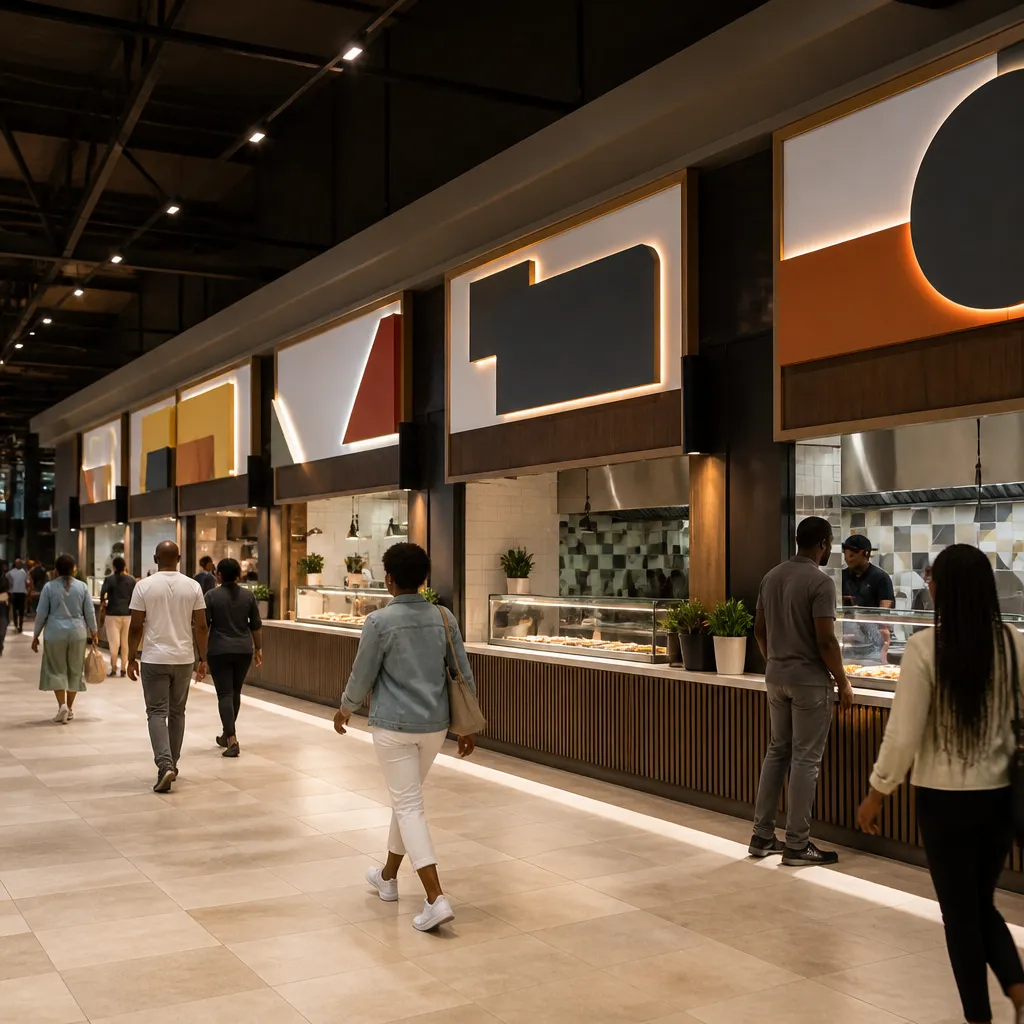
The problem shows up in the first week after opening. The brand with the brightest sign pulls the crowd, the franchise behind a pillar complains that nobody finds it, and the centre manager receives three emails about the same lightbox. Standard retail rules assume you are signing one shop in a row. A food court asks you to design a shared ceiling, walkway and seating zone at once.
Competing identities in one sightline
Franchisors protect their identity closely, and that protection is reasonable. Their logos come with rules on colour, clear space and minimum size, and those rules often contradict each other when four logos share one frame. One brand wants a reversed white logo on dark panels, while its neighbour requires full colour on white. Your job is to find a layout where both comply.
Who pays when the layout changes
If each brand commissions its own fascia, every menu change becomes a bespoke fabrication job. A shared structure lets you replace one panel and leave the rest alone. Decide early whether the centre operator, the landlord or each franchisee carries replacement costs, because that decision shapes the design more than the artwork does.
Setting Corporate Identity Rules Before Design Starts
Ask each franchisor for its current brand pack before you draw anything. A usable brand pack includes logo files, minimum sizes, clear space rules and approved colour values. If a franchisor cannot supply those, do not guess. Request a written standard fallback and log it on the project file.
Building a tenant signage schedule
Turn the brand packs into one schedule with a row per tenant. Each row should list logo size, reversed or full-colour version, illumination type and mounting zone. Share the schedule with every franchisee before the design is approved. Nobody should discover at installation that a neighbour received a larger fascia.
Pro tip: Ask each franchisee to sign off their own row only. Once every brand has approved its own entry, arguments about the other rows tend to fade.
Agreeing who approves changes
Name one approver for signage changes, usually the centre manager or the operator's marketing lead. Agree a fixed response window for requests. Without a named approver, one franchisee's promotional banner can go up on the same afternoon that another brand's request is refused.
Fascia Hierarchy and Sightlines
Treat the fascia line as one continuous band across the court. Use a single datum height for every fascia, and keep the top of each logo panel on the same horizontal line wherever the architecture allows. Where the building forces steps, make the step visible and consistent rather than random.
Setting the fascia datum line
Measure the court from three positions: the main entrance, the centre of the seating area, and the junction where the corridor meets the counters. Mark where a shopper first reads each fascia. If a logo falls below the eye line from the junction, move the datum up for every tenant, not just the one that complained.
A food court sign package is only as good as the rule that stops the loudest tenant from taking the ceiling.
Handling corner units and end caps
Corner units are seen twice, once from each approach, so they need a return panel or a double-sided sign. Avoid giving them an oversized sign, which unbalances the row. In practice, a return panel with the same logo height as the front reads as premium without shouting.
Lighting, Materials and Maintenance Across Brands
Lighting is where food courts drift apart most quickly. One tenant installs bright white LED modules, another chooses warm light, and by evening the court looks like six different designers worked on it. Set one colour temperature and one brightness target for all illuminated fascias, then check the result on site with the lights on at dusk.
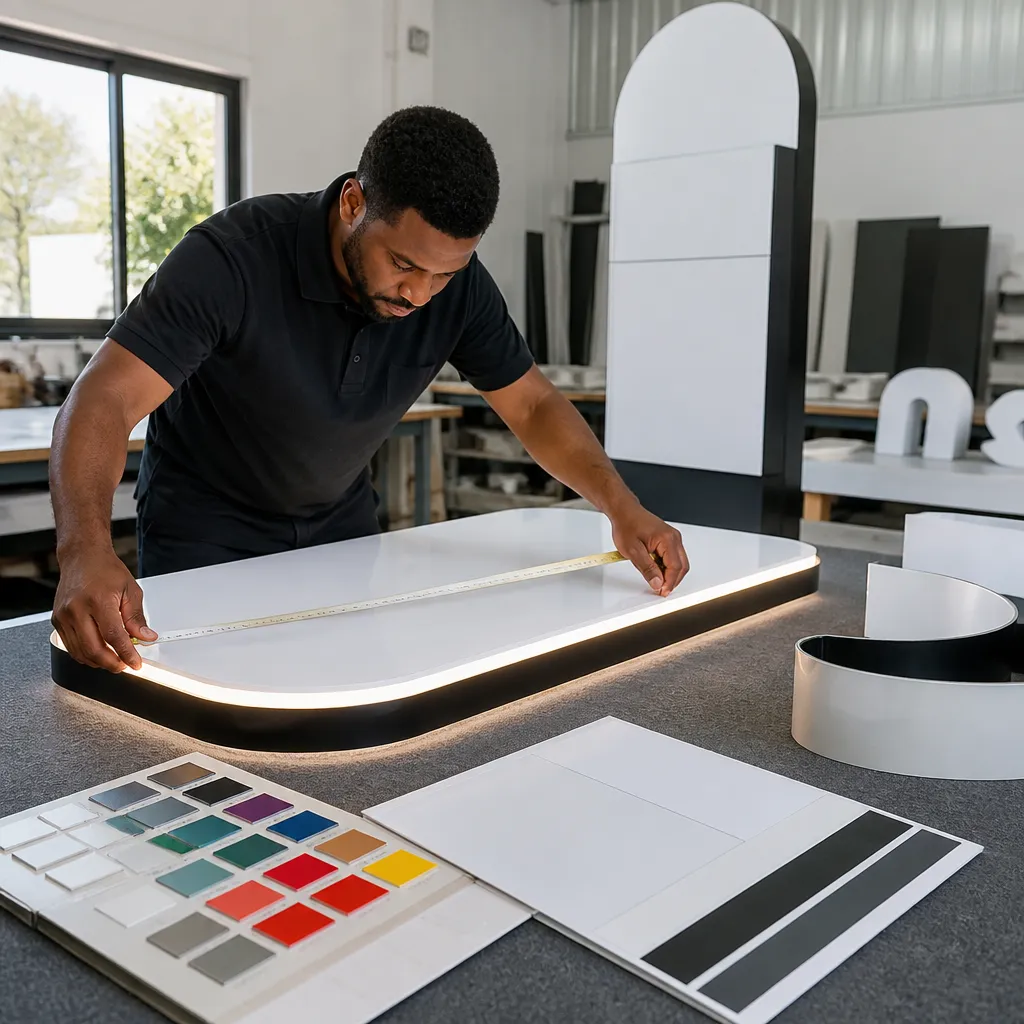
Matching LED brightness and colour temperature
Ask each supplier to state the colour temperature and brightness they will deliver, then test a sample panel beside its neighbour before signing off. Dim, warm fascias next to bright white ones make the whole court look neglected. Where possible, use the same LED module specification across tenants so replacements match.
Materials that survive kitchen grease and humidity
Fryers and extractors push grease into the air, and that film settles on every surface near the kitchen. Specify washable faces, sealed edges and frames that can be cleaned without removing the panel. A sign that looks right on installation day has to look right after a year of steam, which is why our cladding and fabricated signs are specified with cleaning access in mind.
Menu Boards and Ordering Points
Shoppers in a food court often decide what to eat while they walk past the counters, so menu boards must answer three questions quickly: what you sell, what it costs and where to order. Keep the top layer of each board for signature products and prices. Anything more detailed belongs at the counter.
Menu boards that answer one question
A menu board with forty items is a document, not a sign. Give each brand two or three hero products, one clear price column and a single call to action. Move the full menu to the counter or a tablet. The board should be readable from the seating edge, not only from the till.
Queue and collection signage
Ordering points need overhead identification and a clear queue line on the floor. Hang the brand name above each till and use floor markings to show where customers wait. For collection, use a numbered or named shelf sign so people do not crowd the counter while they wait for their order.
Pro tip: Photograph the court during its busiest lunchtime. If customers stand in the wrong lane, the signs are in the wrong place, not the customers.
Wayfinding for Shared Seating
Directional signs in a food court should guide people to the right counter, the right toilets and the right exit, and nothing more. Anything extra creates noise. Use one typeface, one arrow style and one mounting height across the whole court, and keep these directional signs visually separate from the brand fascias.
Directional signs that do not compete
Place directional signs at decision points, such as where a walkway splits or where the seating area meets the counters. Use the centre's own colour scheme for these signs rather than a franchise colour, because they belong to the building, not to any one tenant. Our general informational signs cover the basic information and directional panels a court usually needs.
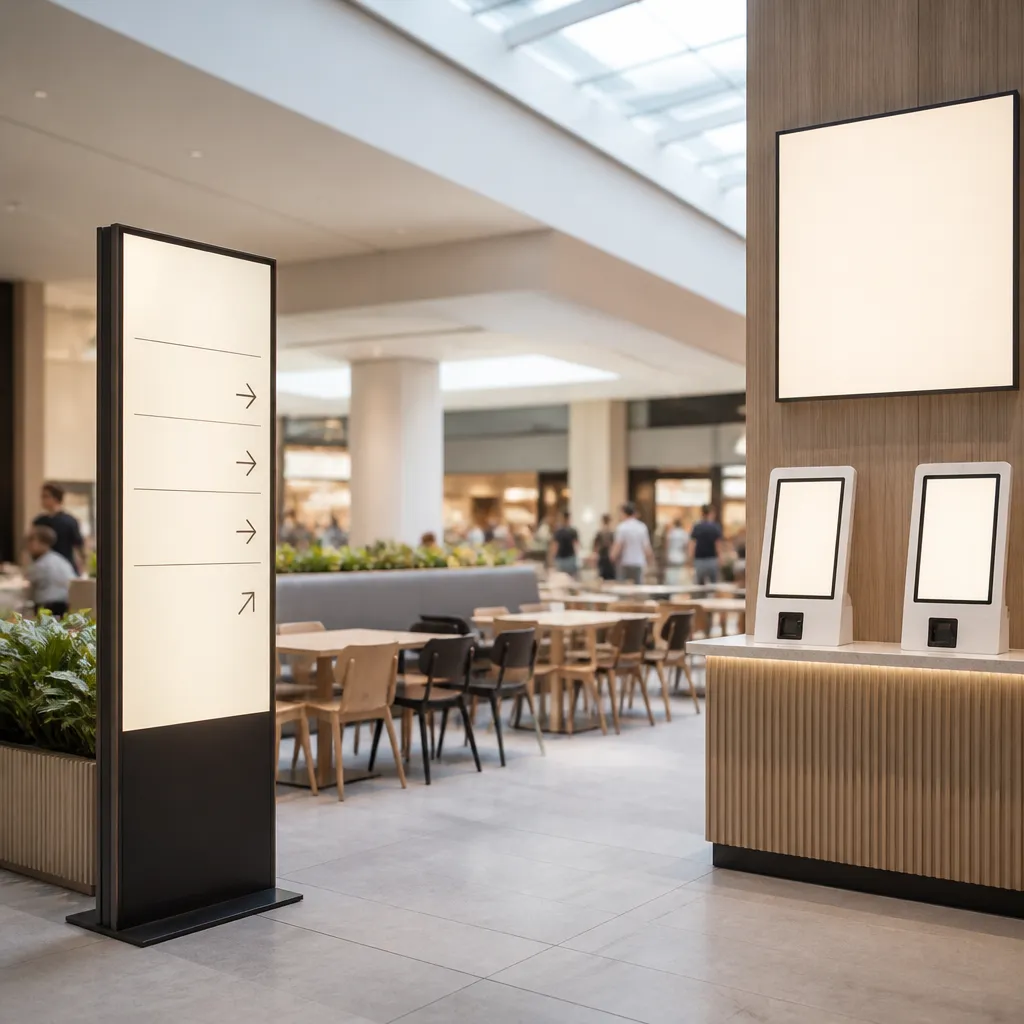
Using a digital screen for changing promotions
A single digital screen can carry rotating promotions for several brands and keep the ceiling clean. Limit each brand to a fixed share of the loop and approve the content on a regular schedule. Do not let the screen become the loudest sign in the court, because shoppers then stop reading the fixed fascias. Our digital signage options can be set up for this kind of shared use.
Choosing a Signage Model for Your Court
No single model suits every centre. The right choice depends on how often tenants change, how much control you want over the ceiling, and who carries the maintenance. The table compares three approaches we see most often.
| Approach | Works best when | Main risk |
|---|---|---|
| Shared frame with replaceable brand panels | Tenants change regularly and you want one maintenance point | Panels can look mismatched if a later print batch differs in colour |
| Individual fascias within a fixed envelope | Each franchisor insists on its own fabrication and finish | The ceiling gets busy fast, and replacements take longer |
| Freestanding totem with tenant panels, plus fascias for end units | The court sits on an open floor and needs a strong landmark from the entrance | Higher upfront cost and structural and approval checks before installation |
For most mixed courts, the shared frame wins. Individual fascias make sense only when a franchisor will not accept a panel and the unit is large enough to carry a full sign without crowding its neighbours.
Rollout, Approvals and Installation Sequencing
Sequence matters more than speed. Approvals for fascias, menu boards and any illuminated sign should be in place before fabrication starts, because a rejected sign costs more than a delayed one. Illuminated or large external signs often need approval from the local authority as well as from the centre, so confirm both before you place an order.
Sequencing approvals before fabrication
Submit one pack per tenant, with drawings, dimensions, illumination details and the brand sheet. Ask the centre to approve the datum line and mounting zone first, then the franchisor, then the local authority where required. Approving in that order means every later sign-off is based on a fixed layout.
Snagging before handover
Walk the completed court at night with every light on. Compare colours side by side, look for dead LED modules, confirm each logo is the right way round, and check that directional signs are visible from the seating area. Record each snag with a photo, an owner and a deadline.
Frequently Asked Questions
How much does food court signage cost in South Africa?
The cost depends on the number of tenants, the illumination, the materials and the installation access. Because every court is different, we quote each project on its own drawings. Call us on 010 500 7667 to request a quote for your site.
Who should approve signage changes in a shared food court?
One named approver should control changes, usually the centre manager or the operator's marketing lead. Agree a fixed response window so requests are answered on a predictable timeline.
Should every franchise have its own fascia?
Only where the franchisor insists and the unit is large enough to carry the sign without crowding its neighbours. In most mixed courts, a shared frame with replaceable panels works better.
How do you keep lighting consistent across different brands?
Set one colour temperature and one brightness target for all illuminated fascias, test sample panels side by side, and check the result at dusk before handover.
What signs does a food court need besides brand fascias?
Most courts need directional signs, menu boards, ordering and queue signs, collection signage, and a small set of information signs for toilets, seating and house rules.
Do food court signs always need to be lit?
No, but lit fascias help in covered courts with limited natural light and make the court readable at dusk. Many operators combine lit fascias with unlit menu boards and directional signs.
If you have managed signage for a shared food court, tell us which part caused the most argument with franchisors and how you resolved it.