


Signage Specification South Africa: Corporate Buyer Guide
A corporate signage order rarely fails on installation day. It fails weeks earlier, when a procurement team sends a brief that reads "illuminated fascia sign, about 3 metres wide" and expects the supplier to fill in the rest. In Gauteng and across the country, we see the same pattern at head offices, franchise sites and hospitality venues. The sign arrives, the brand manager rejects the colour, the landlord refuses the fixing method, and the budget is spent before the first panel is cut. A proper signage specification closes those gaps before a purchase order is raised. This guide sets out what that document should contain, where procurement teams usually go wrong, and how to compare the ordering routes available in South Africa.
Table of Contents
- Quick Takeaways
- What a Signage Specification Sheet Must Contain
- Corporate Identity Standards and Brand Compliance
- Materials, Finishes and Illumination
- Site Surveys, Permits and Installation Constraints
- Comparing Ordering Routes for Corporate Signage
- Tender Documents and Pricing Schedules
- Rental, Maintenance and Lifecycle Costs
- Common Specification Mistakes
- Frequently Asked Questions
- References
Quick Takeaways
| Key Insight | Explanation |
|---|---|
| Write every dimension in millimetres and state the viewing distance | Suppliers price against the drawing you send. A sign sized to the wall plan instead of the fascia edge means a re-make. |
| Attach the brand manual pages that govern logos, colours and clear space | Corporate identity disputes are the most common reason sign approvals stall, and they are almost always avoidable. |
| Name the illumination type, the power supply point and who wires it | LED-backlit and channel lettering need the electrical scope agreed before fabrication starts, not after the sign is built. |
| Make the site survey a signed document before final pricing | Wall condition, landlord consent and access equipment often move the total cost more than the panel materials do. |
| Request line-item pricing for design, manufacture, delivery and installation | Lump-sum quotes hide the variables you need to compare. Line items let you see where a difference actually comes from. |
| Define removal, storage and replacement terms at the start | For rented or time-bound signage, the end-of-contract position decides total cost as much as the purchase price. |
What a Signage Specification Sheet Must Contain
A signage specification sheet is a single document that tells a supplier what to build, where it will be fixed, how it will be illuminated, and who has approved it. Think of it as the contract's technical schedule. If the sheet is vague, the supplier fills the gaps with assumptions, and those assumptions are where cost overruns and rejected installs come from.

Dimensions, Viewing Distance and Sign Area
Give the overall size of the sign structure and the size of the usable sign face as two separate figures. The face is what the brand team cares about, and the structure is what the landlord and the installer care about. Measure to the outer edge of the fascia, not to the wall plan, because a sign drawn to the wall rarely fits the space once the frame is added.
State the viewing distance and the viewing angle as well. A reception sign read from two metres needs a different letter height from a pylon sign read by a driver approaching at speed. In practice, the sheet should include a simple sketch showing the mounting position relative to the entrance, so the supplier can judge legibility without guessing.
Artwork Files and Version Control
Ask for vector artwork for all lettering and logos, and specify the file format you will accept, usually a vector PDF or native design file. Raster images pulled from a website will pixelate once they are enlarged to fascia size, and that is a problem you only discover when the sign is on the wall.
Every artwork file should carry a version number and a date on the specification sheet. A common mistake is approving a PDF in one email chain and then receiving a corrected logo from a different department. Version control prevents two signs being built to two different briefs.
Approval Chain and Sign-Off Responsibilities
Write down who signs off each stage: brand, facilities, the landlord or body corporate where applicable, and finance for the purchase order. Each signature should be against a specific version number. Without that discipline, a facilities manager can approve a sign that the brand team has already rejected, and nobody notices until the installer arrives.
Pro tip: Add a one-page approval block at the end of the specification with fields for name, role, version number and date. It takes ten minutes to set up and it is the fastest way to stop an approval argument from becoming a delay.
Corporate Identity Standards and Brand Compliance
Corporate identity compliance is where many corporate signage projects lose time. Brand teams rarely object to the design concept. They object to a logo clear space that is too tight, a colour that shifts under lighting, or a typeface that was substituted because the supplier did not have the licensed font. All of these can be prevented by putting the right brand rules into the specification.
Pulling the Right Pages from the Brand Manual
Do not attach the entire brand manual to the specification and hope the supplier finds the relevant rules. Extract the pages that govern logo versions, minimum size, clear space, colour values and typography for the sign type you are ordering. A franchise fascia, a внутренний wayfinding panel and a window vinyl usually sit under different rules, and a supplier reading a single generic page will apply the wrong one.
Where a franchise system governs the sign, the franchisor's rules usually override the local brand team's preferences. Name the governing document on the specification so there is no dispute about which standard applies.
Colour Matching Across Materials
The same colour reference will look different on vinyl, painted aluminium and an acrylic face behind LED light. Specifying a colour by reference code alone is not enough, because the substrate and illumination change how that colour appears. A physical swatch or an approved sample panel, signed off before full production, is the only reliable control.
Most colour disputes on signage are not about the colour. They are about the material and the light, and nobody specified either.
Specify the colour reference system you use, the substrate for each element and whether the sign will be lit. If the sign will be illuminated, the sample should be checked at night, because a colour that looks correct in a showroom can read as a different shade once the backlight is switched on.
Materials, Finishes and Illumination
Material and lighting decisions drive both the look and the lifespan of a sign. Procurement teams often choose the cheapest option that meets the drawing, then discover that the same sign needs cleaning, repainting or replacement sooner than expected. The specification should state the environment the sign will live in, not just the size it has to be.
Substrates That Suit Indoor and Outdoor Use
A sign in a covered lobby, a sign on a north-facing or west-facing external wall, and a sign on a fuel forecourt face very different exposure to sun, rain, dust and cleaning chemicals. Name the environment on the sheet and let the supplier recommend substrates against it. A specification that says only "outdoor, durable" gives the supplier no basis for choosing a finish that will hold its colour.
Where the sign is a temporary display or an event piece, say so. Temporary signage can use lighter materials and shorter-life finishes, which reduces cost, but only if the specification says it will be removed after a set period.
Illumination Specification: LED Backlit, Channel Letters and Neon
Illumination needs its own section in the sheet. For LED-backlit boxes, state whether the face should be uniformly lit or whether the logo should be the brightest element. For channel lettering, specify the depth of the letter returns and the type of face. For neon, state the colour and whether the tubes should be visible from the front.
Do not rely on a word like "bright" in the brief. Ask the supplier to describe the lighting approach, show a sample at night if possible, and confirm the lighting hours. A sign that runs eighteen hours a day has different maintenance and power implications from one that is switched on only during trading hours.
Power, Cabling and Electrical Scope
The most common gap in illuminated signage orders is the electrical scope. Who installs the supply point, who runs the cable from the distribution board, who provides the timer or photocell, and who certifies the connection? Each of these should be assigned to a named party in the specification. If the answer is "the supplier will sort it", you will likely pay for that work twice.
Site Surveys, Permits and Installation Constraints
Installation is where a signage project meets the building. A design that looks perfect on screen can fail on a wall with cracked render, a parapet that cannot take the load, or a landlord who has not approved external alterations. A site survey turns those unknowns into facts before anyone commits to a price.
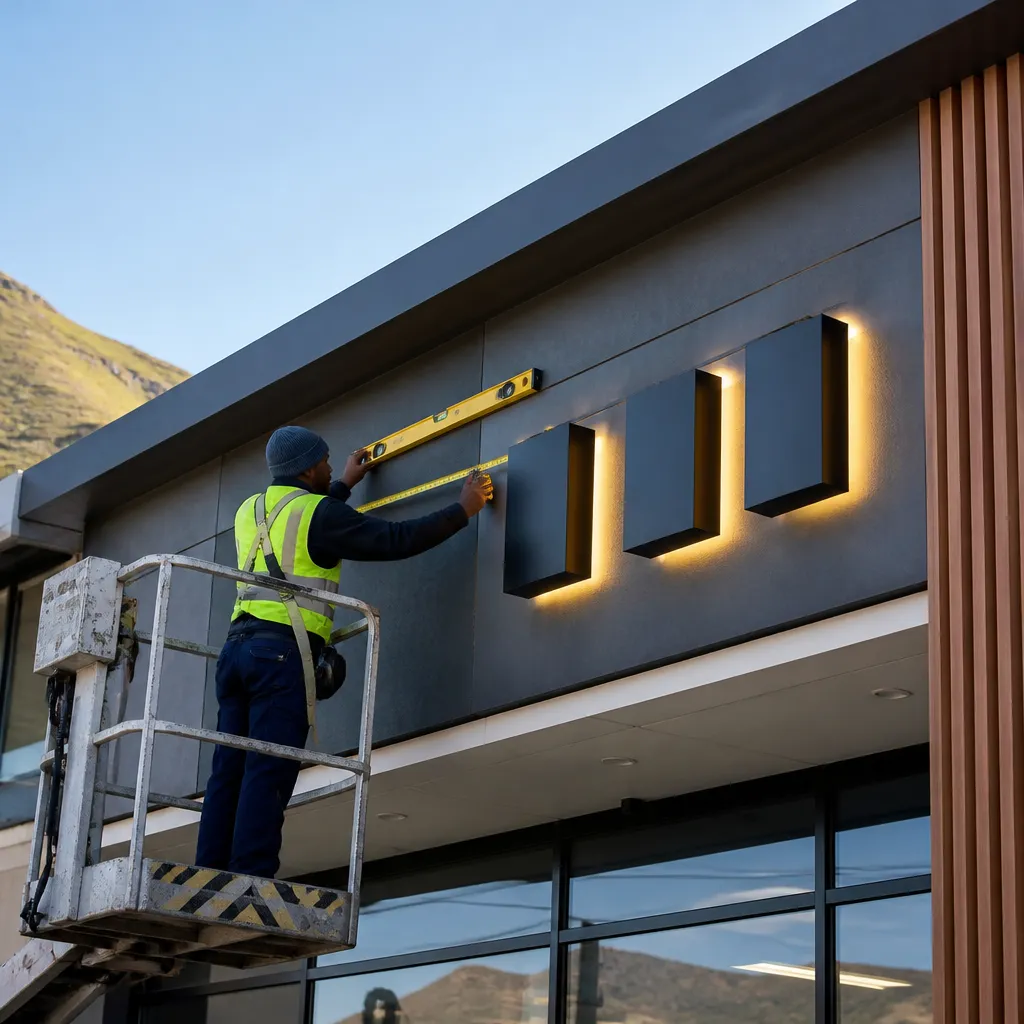
What a Site Survey Should Record
The survey should record the exact fixing surface, its material and condition, the available height and width, and the access route for installation equipment. Photographs with a tape measure in frame are more useful than a verbal description. Note any services in the wall, such as conduits, drainage or cable trays, that could be damaged during fixing.
Record the access constraints as well. A sign on a second-floor facade may need a mobile elevated work platform, and that equipment can require a parking bay, a road closure or a building manager's booking. These costs appear in the installation line, and they are often missing from quotes that only price the sign itself.
Landlord, Body Corporate and Municipal Approvals
Many commercial buildings require landlord or body corporate consent before external signage is installed, and some municipalities require their own approval for large or illuminated signs. The rules differ by building and by local authority, so confirm them with the relevant party rather than assuming an approval is not needed. Write the approval status on the specification, with the reference number once it is granted.
Make the approval a condition of the order where you can. A supplier who has been told that fabrication starts only after written consent will not build a sign that a landlord might later refuse.
Fixing Methods and Structural Load
State the fixing method on the sheet: the type of fixing, the substrate it goes into, and who is responsible for the fixing design. Large illuminated boxes and pylon structures impose real loads on walls and foundations. Ask the supplier to confirm that the structure and fixings suit the wall or base, and ask for the calculation or the engineer's sign-off where the load is significant.
Pro tip: Photograph the fixing surface from three distances before the survey is closed, and attach the images to the specification. If the landlord or installer later disputes the condition of the wall, you have a dated record that settles the question.
Comparing Ordering Routes for Corporate Signage
Procurement teams usually choose between three routes: buying standard catalogue signage, commissioning a custom build to a full specification, or renting signage for a fixed period. Each route suits a different kind of need, and the specification you write should reflect the route you choose. The table below compares them on the points that matter most to corporate buyers.
| Ordering Route | Best For | Main Risk |
|---|---|---|
| Standard catalogue signage | Simple wayfinding and temporary messages where brand precision is less critical | Limited control over colour, sizing and fixing, which can conflict with corporate identity rules |
| Custom fabrication to a full specification | Head office fascias, franchise branding and illuminated signs that must match a brand manual exactly | Cost and lead time rise sharply if the specification is incomplete and has to be revised |
| Rental or hire of signage | Events, pop-up sites and short-term campaigns where removal and storage must be handled by the supplier | Unclear end-of-hire terms, damage liability and replacement costs if the contract is not specific |
Custom fabrication is the route that rewards a strong specification most. The more precisely you describe the sign, the less room there is for interpretation. Catalogue products are faster and cheaper for simple needs, but a corporate team that needs exact colour and logo rules will often find the catalogue route creates more approval rounds than it saves. Rental works well for events, but only when the specification names the removal date, the storage responsibility and the condition the supplier must return the sign in.
Tender Documents and Pricing Schedules
Many corporate and institutional buyers in South Africa run signage purchases through a formal tender or request for quotation, even when the sign is relatively small. The paperwork is strict, and a bid can be disqualified for a missing form even if the design is excellent. Your specification should be written so it can sit inside that process without rework.
Public Tender Paperwork You Will See
A public request for quotation for signage supply and installation, published on the national eTenders portal, covers PRASA Group sites nationwide, including stations, depots and office buildings. The document states that signage is to be provided by the manufacturer, which tells bidders that a reseller without fabrication capability is not the intended supplier. Read that scope line before you assume a distributor can bid.
Another national-level request for quotation requires the bidder to attach a fully completed and signed SBD 3.1 Pricing Schedule and a Price Declaration Form to the bid response. A bid without those forms is at risk regardless of the quality of the design. Build the pricing schedule into your specification so the line items on the sheet match the line items the bidder must return.
Keeping a Procurement File That Survives an Audit
Procurement bodies outside South Africa put similar emphasis on documentation. The California Association of Public Procurement Officials describes three main audit types, compliance, financial and performance, and notes that regular self-assessments keep procurement professionals ready to produce up-to-date documents when an auditor asks. That advice applies directly to signage orders, where the specification, approvals and delivery records should be filed together.
In practice, keep the signed specification, the approved sample, the survey photographs, the landlord consent and the final delivery note in one procurement file for each site. When the sign is questioned months later, the file answers the question without a search through email.
Rental, Maintenance and Lifecycle Costs
The purchase price of a sign is only one part of its cost. Maintenance, cleaning, lamp or LED replacement, repairs after weather damage and eventual removal all add to the total. Procurement teams that compare quotes on purchase price alone often choose the more expensive sign over its life, or they sign a rental agreement that costs more than buying would have.

Why Rental Changes the Specification
When signage is rented, the supplier owns the asset and the contract defines what happens during and after the hire period. The specification must therefore cover the hire period, the installation and removal dates, the storage location if the sign is taken down, and the condition report required at return. Without those points, disputes about damage and missing components are almost certain.
Rental also changes who controls the design. If the sign will be used for a campaign that changes every few months, specify the panel size and fixing system so artwork can be swapped without rebuilding the frame. That single decision can reduce the cost of each new campaign considerably.
Maintenance Responsibility in the Contract
A published airport signage contract in the research places the duty to maintain all signage on the contractor, and treats the specification and requirements as the full description of the works. That is the model a corporate buyer should aim for. If the supplier is responsible for keeping the sign clean and working, the specification should say how often inspections happen and how quickly faults must be fixed.
Where the buyer maintains the sign in-house, the specification should name the maintenance tasks, the access arrangements and the spare parts the supplier must hand over at installation, such as spare LED modules or a set of fixings. Without spares, a single failed module can leave a sign dark for weeks while parts are sourced.
Pro tip: Ask every supplier for a five-year cost view that lists the expected cleaning, repair and replacement items. A supplier who cannot describe those costs has probably not thought through the maintenance of the sign they are proposing.
Common Specification Mistakes
Most failed signage orders trace back to a short list of mistakes. They are easy to avoid once you know what to look for, and most of them are visible on the first read of a draft specification.
Specifying the Sign but Not the Installation
A specification that describes the sign face in detail but says nothing about fixing, access, electrical supply or making good the wall after removal leaves the most expensive work unpriced. Installation is often the largest single cost on a large fascia or pylon. Treat it as a separate scope with its own line items and its own acceptance criteria.
Approving by Email Instead of by Version
Approval by email is not a problem in itself. The problem is approval of an unnamed attachment. If the approval email does not quote the version number and the date of the specification, you cannot prove what was approved. Use the approval block described earlier, and require the signature against the version, not the thread.
Ignoring the Light at the Installation Site
A sign specified in a showroom can look very different on a street with strong daylight, reflective glass or a neighbouring building that throws shade. Check the sign's legibility at the actual site, at the times it will be read. This is especially important for signs that must be seen from a road or a car park, where readability decides whether the sign does its job at all.
Frequently Asked Questions
What is the most important part of a signage specification in South Africa?
The most important part is the combination of accurate dimensions, approved artwork and a clear installation scope. Dimensions and artwork tell the supplier what to build, and the installation scope tells the supplier who fixes it, powers it and makes good the wall afterwards. A specification that misses any one of these will usually cost more than it saves.
Do we need a site survey before we request quotes?
Yes, for any sign that is fixed to a building or structure. A survey confirms the fixing surface, the access route and the services in the wall, and it gives suppliers the information they need to price the installation accurately. Quotes made without a survey almost always change once the installer sees the site.
How should a corporate team compare signage quotes?
Compare quotes line by line against the same specification. Ask for separate prices for design, manufacture, delivery and installation, plus any electrical, permit and removal costs. A lump-sum price that is lower than the others often means one of those items has been left out or assumed.
Can a franchise owner order signage without the franchisor's approval?
In most franchise systems, no. The franchisor's brand standards usually govern the fascia, colours and logo use, and the franchisee must follow them. Check the franchise agreement and the brand manual before you finalise the specification, so the supplier builds to the rules that actually apply to your site.
What should happen to rented signage at the end of the hire period?
The rental agreement should set out the removal date, the storage responsibility, the condition the sign must be returned in and the process for recording any damage. Ask for a joint inspection at return, and photograph the sign before it is removed so any dispute about condition has a clear reference point.
Why does colour look different on the final sign?
Colour changes with the substrate, the finish and the lighting, so a reference code on its own does not guarantee the same result. Approve a physical sample under the lighting conditions the sign will actually use, and check it at night if the sign is illuminated.
Have you run a signage order through a formal tender or a corporate approval chain in South Africa? Tell us what you would add to this specification checklist, and what caused the most delay on your last project.
References
- Global procurement best practices from a public procurement association in California
- South African request for quotation requiring a pricing schedule and price declaration form
- National eTenders request for quotation for supply and installation of signage at PRASA sites
- Overview of procurement management practices and contract control