


Co-Working Space Signage South Africa: Brand Without a Lease
Your brand does not pause because your lease does. Yet many businesses operating in co-working spaces and serviced offices across South Africa treat signage as an afterthought, assuming that because they cannot bolt something permanently into a wall, they cannot brand meaningfully at all. That assumption is costing them clients, credibility, and competitive edge. Co-working space signage in South Africa is now a serious discipline, not a workaround, and the businesses getting it right are the ones treating flexibility as a feature, not a compromise.
Table of Contents
- Quick Takeaways
- Why Flexible Workspace Signage Matters Now
- The Signage Challenge Unique to Co-Working and Serviced Offices
- Signage Types That Work in Flexible Workspaces
- Comparison: Signage Approaches for Flexible Office Tenants
- Serviced Office Signage in Gauteng: What the Market Expects
- Signage Rental: The Smart Answer to No Permanent Fixtures
- Maintaining Corporate Identity Standards Across Multiple Flexible Locations
- Frequently Asked Questions
- References
Quick Takeaways
| Key Insight | Explanation |
|---|---|
| Non-permanent does not mean non-branded | Free-standing display stands, portable pull-up banners, and tension fabric frames let you brand a co-working space fully without drilling a single hole. |
| Rental signage is purpose-built for flexible tenants | Signage rental solutions let you maintain a professional presence in serviced offices without capital outlay tied to a space you may vacate in 90 days. |
| Gauteng co-working hubs are increasingly brand-competitive | In Sandton, Rosebank, and Midrand, the density of businesses sharing buildings is high. Signage is how your clients and visitors identify you before they reach your desk. |
| Corporate identity rules still apply | Franchises and multi-location corporates using flexible offices must apply the same CI standards to temporary signage as they would to a permanent fit-out. |
| LED-backlit and illuminated signs work in shared lobbies | Freestanding LED-backlit signs create presence and premium perception in shared reception areas without requiring any infrastructure changes. |
| Signage brief must account for venue restrictions | Most co-working operators prohibit adhesive wall applications. A well-briefed signage supplier will design within those restrictions from the start, not after fabrication. |
| Event and meeting room signage is an overlooked opportunity | When you host clients in a shared meeting room, directional and branding signage turns a generic space into a branded client experience. |
Why Flexible Workspace Signage Matters Now
South Africa's flexible office market has moved well past the start-up phase. Companies of all sizes, from growing SMEs to enterprise teams running hybrid arrangements, are actively using co-working spaces and serviced offices as their primary or secondary work address. Cape Town saw co-working locations grow from 16 in 2020 to well over 100 by late 2025, according to available market data, and Johannesburg's Sandton and Rosebank nodes tell a similar story.
The global coworking market is on a strong growth trajectory, and Africa is accelerating faster than most regions. That expansion means more competitors sharing the same building, the same lobby, and sometimes the same floor. In that environment, the question is not whether you need signage. The question is whether your signage communicates a brand that belongs in the building or a business that is just passing through.
A business that looks temporary is treated as temporary. Signage is the fastest signal you can send that you intend to be taken seriously, regardless of what your lease says.
The Signage Challenge Unique to Co-Working and Serviced Offices
Fixed signage is the default in a traditional office fit-out. You commission it once, install it, and it stays. Co-working and serviced offices break almost every assumption that default rests on. The walls belong to someone else. The building directory is shared. You may be in a different suite next quarter.
What Most Tenants Get Wrong
The most common mistake is waiting. Tenants move into a serviced office, assume they cannot do anything meaningful with signage, and end up relying entirely on a small name badge in the building directory. That is not branding. That is a listing.
The second mistake is over-committing. Some tenants commission fully fabricated wall-mounted channel lettering for a space they have on a rolling three-month agreement. When they move, the sign cannot come with them and the deposit covers the removal damage. The right signage for a flexible workspace is designed to move with you, and a good supplier will tell you that before you spend the money.
The Venue Restriction Problem
Most co-working operators prohibit permanent adhesive applications, structural fixings, and anything that alters the building's appearance from common areas. This is reasonable from their perspective and it is entirely workable from a signage perspective, provided you plan for it. Free-standing structures, tension fabric displays, and modular display systems exist precisely for environments like these. The restriction is not a dead end. It is a design brief.
Pro tip: Before briefing your signage supplier, request a copy of the co-working operator's tenant fit-out guide or house rules. Most have one. Share it with your supplier at the start of the conversation, not after designs are approved. This saves time, money, and the frustration of fabricating something you cannot actually use.
Signage Types That Work in Flexible Workspaces
Not all signage categories are equally suited to flexible workspaces. Some are excellent. Others are a waste of budget. Here is a clear-eyed view of what works and what does not, based on the constraints co-working and serviced office tenants actually face in South Africa.
Pull-Up and Retractable Banners
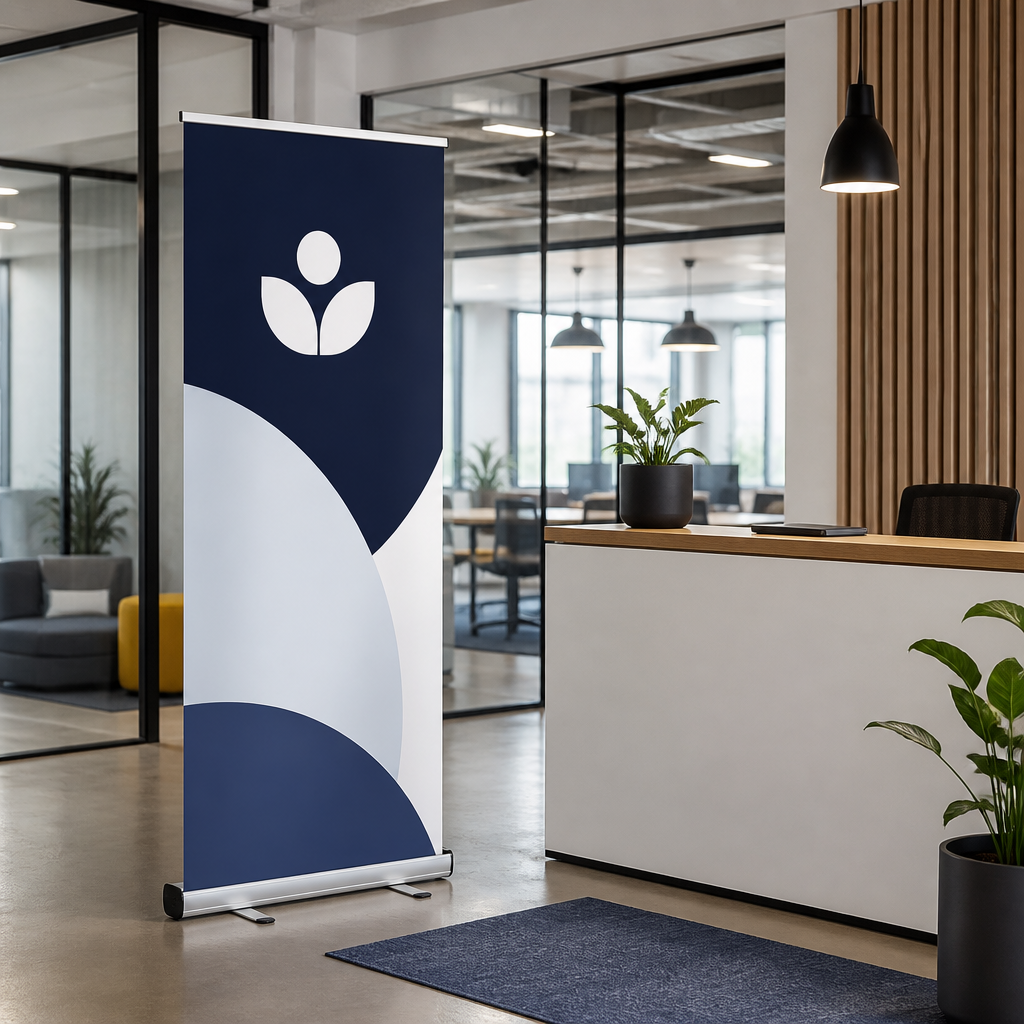
Pull-up banners are the workhorse of flexible workspace branding. They are portable, affordable, and can be set up in under two minutes. For a reception area, a meeting room, or a shared lobby, a well-designed pull-up banner with your logo, brand colours, and a clear brand message does more than most people give it credit for. The print quality is the deciding factor. A banner with pixelated graphics or off-brand colours does more damage than no banner at all.
Tension Fabric Frames and Display Stands
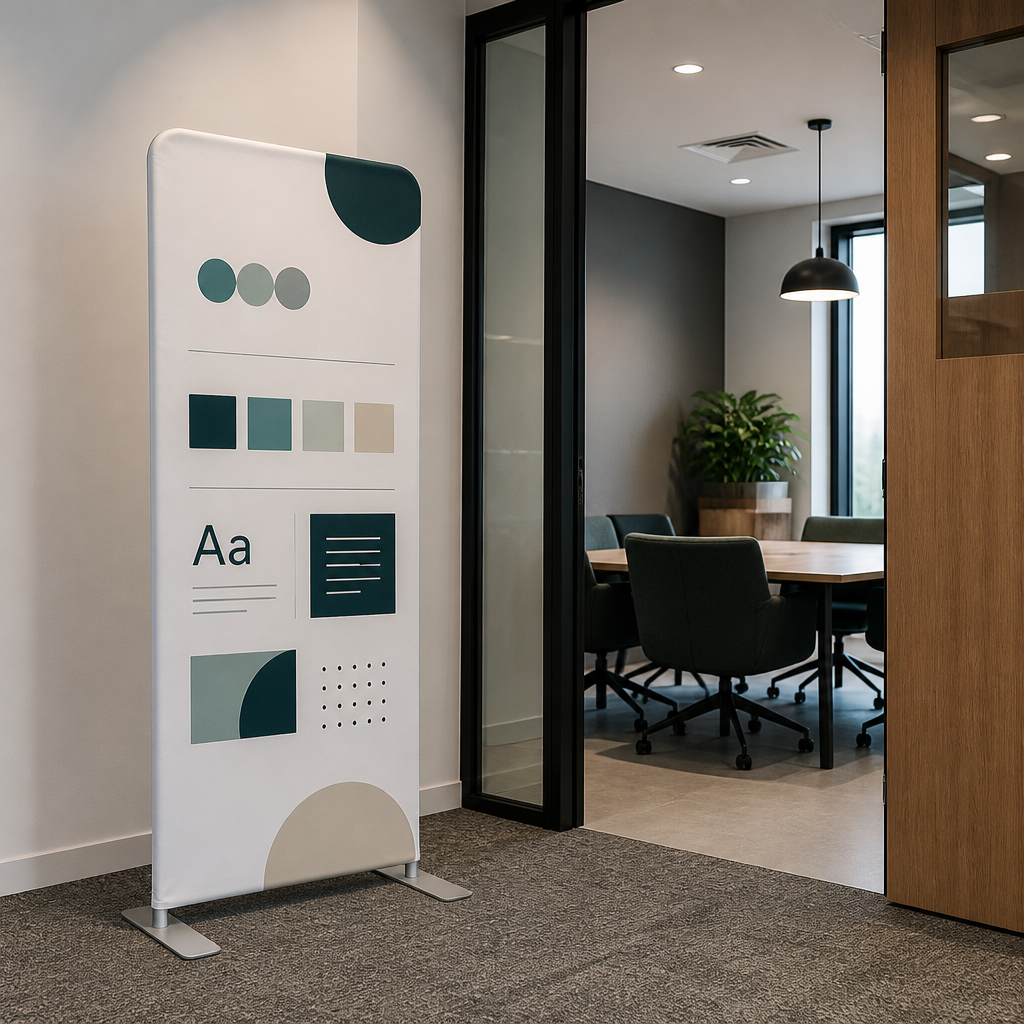
Tension fabric systems offer a step up in presence. A backlit fabric frame standing in a reception area commands attention in a way that a rolled banner simply cannot. These systems are modular, so the frame travels with you and only the graphic panel needs updating when your brand or messaging changes. For businesses in Gauteng serviced offices that host regular client meetings, this format creates a genuinely impressive first impression without any permanent installation.
LED-Backlit Freestanding Signs
For businesses that want to project a premium, corporate-grade presence in a shared space, freestanding LED-backlit signage is the right tool. These units are self-contained, require only a standard power point, and can be repositioned as needed. In a shared lobby or co-working lounge, an illuminated sign with your brand identity is unmistakable. It signals investment, stability, and professionalism.
Directional and Wayfinding Signage
This category is consistently underused by businesses in shared offices. When a client visits your team in a building they have never been to, the experience of navigating to your specific suite or desk area shapes their first impression before they even meet anyone. Portable directional stands at building entrances, lift lobbies, and corridor junctions make that navigation effortless. They can be personalised with your brand and removed when not needed.
Window and Glass Graphics
If your serviced office has a glass partition, window, or glazed meeting room, removable window vinyl is one of the most effective and reversible ways to brand that space. Frosted or printed vinyl applies without adhesive damage concerns in most co-working environments, and it creates visual privacy while reinforcing your brand at the same time. Always confirm reversibility with your venue before proceeding.
Comparison: Signage Approaches for Flexible Office Tenants
Choosing the right signage approach comes down to three factors: how long you expect to be in the space, how often you host clients on-site, and what level of brand presence your corporate identity requires. The table below compares the three most relevant approaches for South African businesses in co-working and serviced office environments.
| Approach | Best For | Key Considerations |
|---|---|---|
| Portable and freestanding signage (owned) | Businesses in flexible offices for 6+ months; teams that move between locations regularly; franchises needing consistent CI across multiple flexible sites | One-off production cost; fully portable; can be rebranded with new graphics; no venue permission required for most formats; ideal for companies with strict corporate identity standards |
| Signage rental | Short-term tenants (under 6 months); event-specific branding in meeting rooms; businesses testing a new Gauteng location before committing | Managed cost with no capital outlay; supplier handles logistics and installation; graphics can be swapped per campaign or location; particularly useful for product launches or temporary satellite offices |
| Permanent or semi-permanent signage | Businesses in serviced offices with longer-term agreements (12 months+) where the operator permits it | Requires explicit written venue approval; higher production and installation cost; not portable; most appropriate when the space has been negotiated as a dedicated, branded suite rather than a hot-desk or shared arrangement |
Serviced Office Signage in Gauteng: What the Market Expects
Gauteng remains South Africa's primary commercial hub, and areas like Sandton, Rosebank, and Midrand are home to a dense concentration of serviced offices and co-working spaces. The businesses operating in these environments are often client-facing, regularly hosting meetings with corporate decision-makers, procurement teams, and executive visitors.
In this context, office branding in Gauteng carries a higher reputational stake than it might in a lower-footfall environment. A visitor arriving at a meeting in a Sandton serviced office will pass through a lobby, possibly wait in a shared reception area, and navigate shared corridors. Every touchpoint is an opportunity to reinforce or undermine confidence in your brand.
What the Corporate Client Notices
Corporate clients notice three things: whether they could find your space without phoning you, whether the environment looks like it belongs to you or just near you, and whether the quality of your materials matches the quality of your pitch. Directional signage, a branded display in the meeting room, and a freestanding sign at your suite entrance address all three. The absence of any signage creates an impression of impermanence that contradicts even the strongest verbal or written proposal.
Pro tip: For businesses hosting regular client meetings in a serviced office meeting room, a compact branded display stand placed in the room before the client arrives takes under five minutes to set up and immediately transforms a generic shared space into a branded environment. It is one of the highest-return signage investments available to flexible office tenants.
Franchise Networks in Flexible Spaces
Franchise operations face an additional layer of complexity. Franchise agreements typically mandate strict adherence to corporate identity guidelines, including specific Pantone or CMYK colour values, approved typefaces, and defined logo usage rules. When a franchisee operates from a co-working or serviced office, those CI requirements do not relax. A franchisee who produces off-brand signage to save cost or time creates a brand consistency problem that reflects on the network as a whole.
Working with a signage supplier that understands CI compliance, and can produce work to the exact specifications in your franchise manual, is not optional. It is a contractual necessity. The right supplier will request your brand guidelines as the first step, not as an afterthought.
Signage Rental: The Smart Answer to No Permanent Fixtures
Signage rental is one of the most underused tools available to South African businesses in flexible workspaces, and it is particularly well-suited to the co-working context. The model is straightforward: instead of purchasing signage outright, you pay a rental fee that covers the hardware, graphics production, delivery, and often installation. When your tenancy ends or your messaging changes, the provider manages the transition.
For businesses that are actively expanding into new Gauteng locations, testing a new market, or operating a temporary satellite office, rental removes the capital decision entirely. You get professional, CI-compliant signage without committing budget to assets that may become irrelevant in the next business cycle.
What to Clarify Before Signing a Signage Rental Agreement
Not all rental arrangements are structured the same way. Before committing, clarify who is responsible for graphic updates when your campaign changes, what the minimum rental period is, how quickly the provider can swap out hardware if something is damaged, and whether the agreement covers installation and collection at both ends. A rental solution that leaves logistics to you has largely missed the point.
Signage rental across Africa, including into neighbouring markets like Botswana, Zimbabwe, and Mozambique, is possible when working with a supplier that has cross-border experience. For businesses with operations beyond South Africa's borders, this matters more than it might appear. Brand consistency does not stop at Beit Bridge.
Maintaining Corporate Identity Standards Across Multiple Flexible Locations
The defining challenge for corporates and franchises using flexible workspaces across multiple cities or regions is not producing one good sign. It is producing consistent signage across ten, twenty, or fifty locations where each building has different rules, different dimensions, and different lighting conditions.
This is where the supplier relationship matters more than the product. A signage partner that produces to your CI spec, adapts formats for different environments, and manages the logistics of delivery and installation across locations is fundamentally different from a print shop that produces what you specify and ships it to your door.
A Practical System for Multi-Location Flexible Workspace Branding
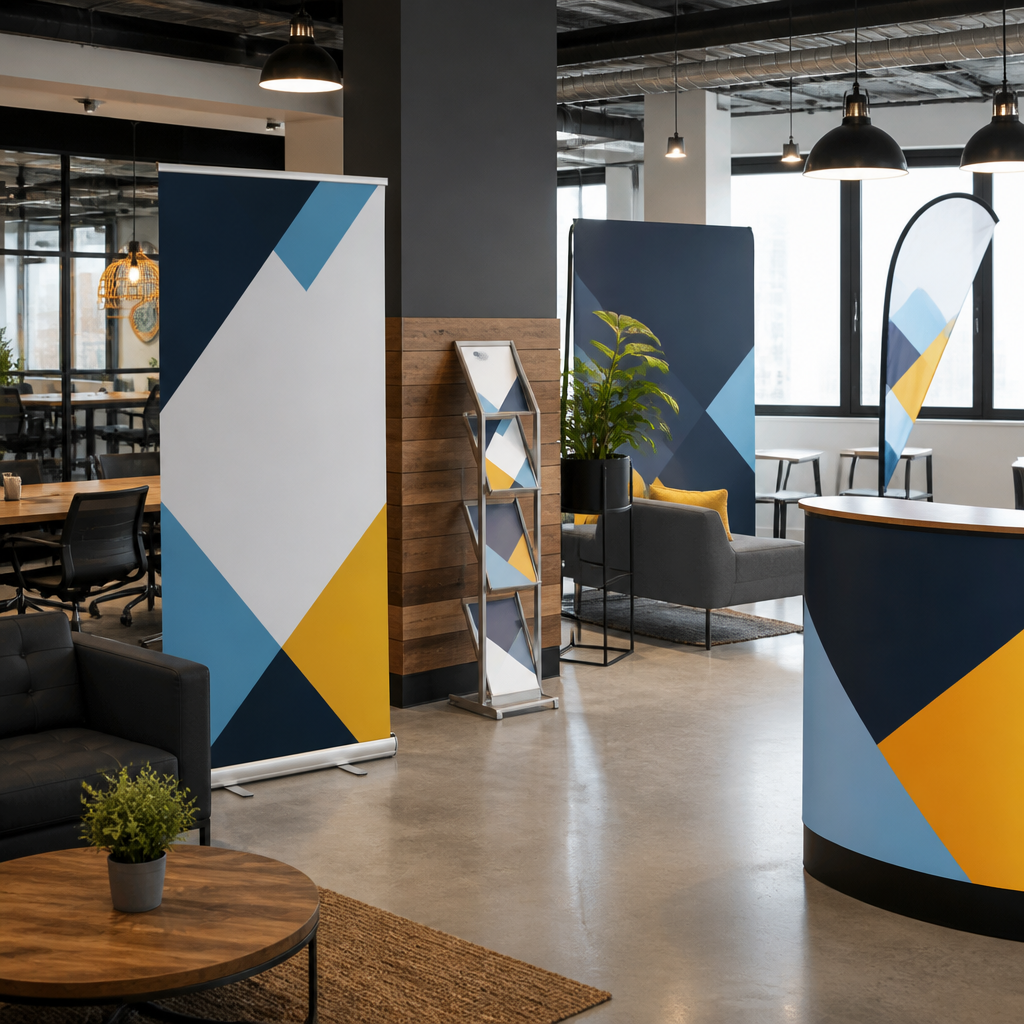
The most reliable approach is to develop a modular signage kit for your flexible office presence. This typically includes a branded pull-up banner for reception or entrance areas, a tension fabric or LED-backlit display for client-facing spaces, a directional stand for building lobbies or corridors, and printed collateral holders for meeting rooms. Each component is produced to exact CI spec, can be shipped flat or in compact carry cases, and can be deployed by any team member without specialist knowledge.
The kit approach means every location gets the same standard of presentation. A client visiting your Sandton team and then your Midrand team should see the same brand at both, even if the office space looks completely different behind it.
The materials matter too. For locations across South Africa where air conditioning can be aggressive and sunlight through windows harsh, UV-stable, fade-resistant print materials are not a luxury specification. They are the difference between signage that looks sharp in month six and signage that has visibly deteriorated by month three.
Frequently Asked Questions
Can I install signage in a co-working space if I do not own the premises?
Yes, but the key is choosing formats that do not require permanent installation. Free-standing display stands, pull-up banners, tension fabric frames, and portable LED-backlit signs all work without drilling, adhesive, or any modification to the building. For window vinyl or frosted glass graphics, you will need written approval from the co-working operator first. Most operators are willing to accommodate removable applications if you ask in advance.
What is the difference between signage rental and buying signage outright?
When you buy signage, you own the asset and are responsible for storage, maintenance, and logistics. When you rent, the supplier typically manages all of those elements for an agreed periodic fee. Rental is generally more cost-effective for short-term tenancies or when you need signage for a specific campaign or temporary location. Buying outright makes more sense when the same signage will be used consistently across multiple locations over an extended period.
How do I maintain my franchise's corporate identity standards when using a serviced office?
Work only with a signage supplier who formally requests your brand guidelines and produces to those exact specifications, including colour values, typeface, logo placement rules, and approved materials. Portable and freestanding formats can be produced to full CI compliance. The format of the sign changes when you move to a flexible workspace. The standard of the brand expression should not change at all.
What signage works best in a shared lobby or reception area?
Freestanding LED-backlit signs and tension fabric displays create the strongest brand presence in shared lobbies without requiring any permanent installation. They are visually distinct, illuminate your brand identity in varied lighting conditions, and can be repositioned as needed. For spaces where floor space is limited, a high-quality retractable pull-up banner in the right position achieves a similar result at a lower cost.
Is there a minimum order or engagement size for flexible workspace signage solutions?
This depends on the supplier. For businesses looking for a single pull-up banner or a modest display kit for one location, a good supplier should be able to assist without requiring a large-scale project. For multi-location requirements across Gauteng or across multiple provinces, a more structured engagement makes sense. The key question to ask any supplier is whether they can scale the solution with you as your flexible office footprint changes.
How should I handle signage when I move between co-working locations?
Design your signage to be location-agnostic from the start. Avoid including physical addresses on any portable signage, and use brand messaging that is relevant wherever you operate. This way, the same display stand, banner, or LED unit can move with your team from one location to the next without requiring reprinting. When your messaging needs updating, only the graphic panel changes, not the hardware frame, which keeps update costs low.
What signage formats are most effective for client meetings in shared meeting rooms?
A compact branded display stand or table-top tension fabric display, set up in the meeting room before the client arrives, is the most practical and impactful option. Pair it with branded printed materials and, where the room has a glass wall or partition, a removable window vinyl panel with your logo. The goal is to make the shared room feel like your space for the duration of the meeting, which builds client confidence and reinforces your brand at a critical decision-making moment.
What type of signage have you found most effective for your co-working or serviced office environment? Share your experience or questions below.
References
- The rise of co-working spaces in South Africa: market growth data and flexible workspace trends
- Global coworking spaces market size, share and regional forecasts including South Africa
- Overview of flexible office space types available to businesses in South Africa
- How flexible workspaces benefit corporate tenants and employees in South Africa
- Serviced offices and co-working space options across Gauteng and Johannesburg