


Sports Club Signage in South Africa: Identity and Safety
Walk onto most community sports fields in Gauteng and you will see the same problems: a clubhouse with a hand-painted name, a sponsor board that faded before the season ended, and a gate sign nobody can read from the road. Sports club signage in South Africa is not decoration. It tells a new parent where to park, tells a driver whether the entrance is safe, and tells a sponsor whether their money was worth spending. This guide covers the three jobs signage has to do at a club or community venue: carry a consistent identity, stay safe and compliant, and make sponsorship boards pay their way.
Table of Contents
- Quick Takeaways
- Club Identity That Survives Committee Changes
- Permits and Municipal Rules Before You Order
- Safety and Visibility at Gates, Pitches and Parking
- Sponsorship Boards That Earn Renewals
- Choosing Sign Types for Each Venue
- Maintenance, Rental and Temporary Signage
- Frequently Asked Questions
- References
Quick Takeaways
| Key Insight | Explanation |
|---|---|
| Get the municipal position in writing before you order | Under the Western Cape outdoor advertising by-law, locality-bound signs must relate to the lawful use of the property. A sign that names your club and its facilities sits in a different position from a panel advertising an unrelated product, so ask the municipality which category your sign falls into. |
| Build one master identity file | Clubs change treasurers, coaches and kit suppliers faster than they change their name. A file with approved colour references, typeface rules and clear-space rules keeps the gate sign, scoreboard and sponsor boards consistent for years. |
| Keep road-facing text to a few words | A driver passing at speed has seconds. Put the club name and one line of direction on the sign, and move fixtures, history and sponsor messages to secondary panels. |
| Fix pitch-side boards away from the ball line | Boards along a pitch take impacts every match. Mount them behind a protective face and use fixings that will not pull out when the fence flexes, or you will replace panels every season. |
| Sell sponsor boards by visibility, not by size | A board facing the clubhouse terrace or the car park entrance is worth more than one hidden behind a practice net. Price packages by where the board is seen, then show the sponsor a photograph taken from that spot. |
| Rent for tournaments, buy for permanent sites | Event banners and temporary stands rarely justify a permanent purchase. Spend permanent budget on the gate, the clubhouse and the main sponsor wall. |
| Inspect every season before the first fixture | Loose fixings, faded vinyl and failed lights cause most complaints. A walk-round before the season starts catches them while they are still cheap to fix. |
Club Identity That Survives Committee Changes
Most clubs did not design their signage as a system. The gate sign was added after a fundraiser, the scoreboard came from a supplier who had a spare panel, and the clubhouse lettering was painted by a member who has since moved away. Within a few years the venue looks like three different organisations sharing one fence line.
The fix is a master identity file: a short document that sets out the club crest, the approved colours in the exact references your printer uses, the typeface, and the minimum clear space around the crest. Give it to every supplier, including the people who make your kit banners and the people who make sponsor boards.
We would love your feedback and any insights you would share with others. What perspective would you add?
Colour references, not colour descriptions
Navy on a shirt, navy on a vinyl banner and navy on a backlit acrylic face are three different colours. Specify each colour by its printer or paint reference, and ask your sign maker to proof against that reference in daylight. An LED-backlit sign shifts colour under its own light, so proof it switched on as well as switched off.
Where the club name belongs
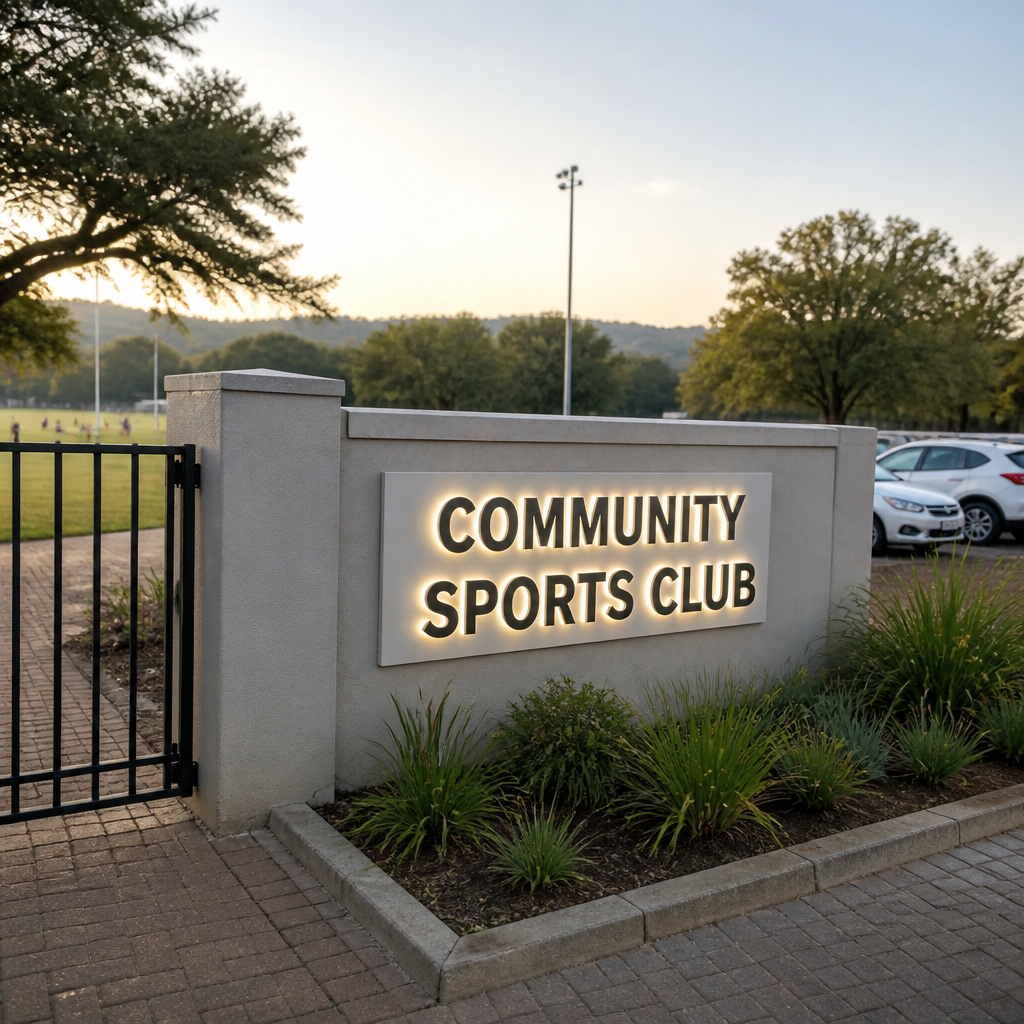
The club name should be the largest and most legible element on any road-facing sign. Sponsor logos sit lower or on separate panels, sized to a consistent ratio. A common mistake is giving every sponsor the same prominence as the club, which turns the gate into a noticeboard that nobody reads from the road.
Corporate identity discipline is not only for banks and franchise groups. A community venue that hosts a provincial league fixture or a school tournament gets photographed and visited by people who have never been there before, and the sign at the gate is the first thing they judge.
Pro tip: Store the master file with the original vector artwork, not only a PDF. When a panel needs replacing, the supplier needs the editable logo and the colour references, and a missing file often means the logo gets redrawn slightly wrong.
Permits and Municipal Rules Before You Order
Clubs usually discover the rules after the sign is installed, which is the most expensive time to learn them. Signage at a sports or community venue sits under a stack of local controls, and the rules change depending on where the venue is and whether the sign promotes the club or a third party.
The Western Cape Outdoor Advertising and Signage By-law, 2008, shows how these rules are framed. It requires locality-bound signs to relate to the lawful use of the property. A club sign that names the club and its facilities is in a simpler position than a board advertising a sponsor's unrelated product on the same boundary wall.
Locality-bound versus third-party signs
In practice, the question is whether the sign relates to what happens on the property. A sponsor board promoting a drink sold in the clubhouse is easier to justify than a billboard-style panel for a car dealership on the perimeter fence. Write that distinction into the sponsorship agreement before the design is drawn, not after a complaint arrives.
Tshwane and the difference between advertising and traffic signs
The City of Tshwane publishes a guide to displaying advertising signs and advertisements, and it treats outdoor advertising signs separately from traffic signs. Clubs near busy roads often blur that line with directional arrows, event boards and logos on one face. If your sign points drivers to a car park or ground entrance, check whether the municipality treats it as directional signage or advertising before you approve a design that mixes both.
The national Revised South African Manual for Outdoor Advertising Control, known as SAMOAC, is a framework and guideline document meant to standardise assessment criteria and control measures across South Africa. It is worth reading if you want to understand the logic behind local decisions. If you are unsure whether a sign needs approval, ask the municipality in writing and file the reply. A verbal assurance from a committee member who has since moved on will not help you at the next inspection.
Safety and Visibility at Gates, Pitches and Parking
Safety signage at a venue has two jobs: direct people safely and warn them of hazards. Most clubs focus on directions and ignore hazard warnings until a child walks into a floodlight pole or a car reverses onto a pitch access route.
A club sign is only as good as its ability to be read by someone in a moving car, in the rain, at dusk.
Gate and entrance signs that work at speed
A gate sign should be readable from the point where a driver first decides to turn in, not from the gate itself. Keep the club name large, use high-contrast colours, and position the panel so that streetlights and headlights do not wash it out. Illuminated panels help after dark, but they need an electrical circuit that can carry the load, and a qualified electrician should certify the installation.
Pitch-side and fence-line boards
Boards along a fence or pitch take impacts from balls, equipment and the occasional player. Fix them behind a protective face, use fixings rated for the fence type, and keep sharp edges away from the spectator side. Replace cracked polycarbonate immediately, because a broken edge is a liability as well as an eyesore.
Pro tip: Walk the venue after dark with the floodlights on before you sign off the installation. Glare, dark corners and unlit directional signs show up clearly at night and are easy to miss in the morning.
Parking and pedestrian routes deserve the same attention. Clear directional signs at the entrance reduce the number of cars circling the car park, which in turn reduces the risk near children's play areas. Keep each sign to a few words and match the arrows to the actual layout on the ground.
Sponsorship Boards That Earn Renewals
A sponsorship board only pays if the sponsor can see it, the club can deliver an audience, and the board is still there when renewal comes around. Most clubs sell boards at a flat rate per panel, then wonder why renewals drop after one season.
Sponsors also judge the business case. A 2018 study by M Goldman, held in the University of San Francisco repository, examined whether companies with sports sponsorship in South Africa see financial returns that differ from those without it. A club should not treat that study as proof that any given board will sell, but it shows that the question is being asked seriously by the people who approve budgets.
Price by visibility
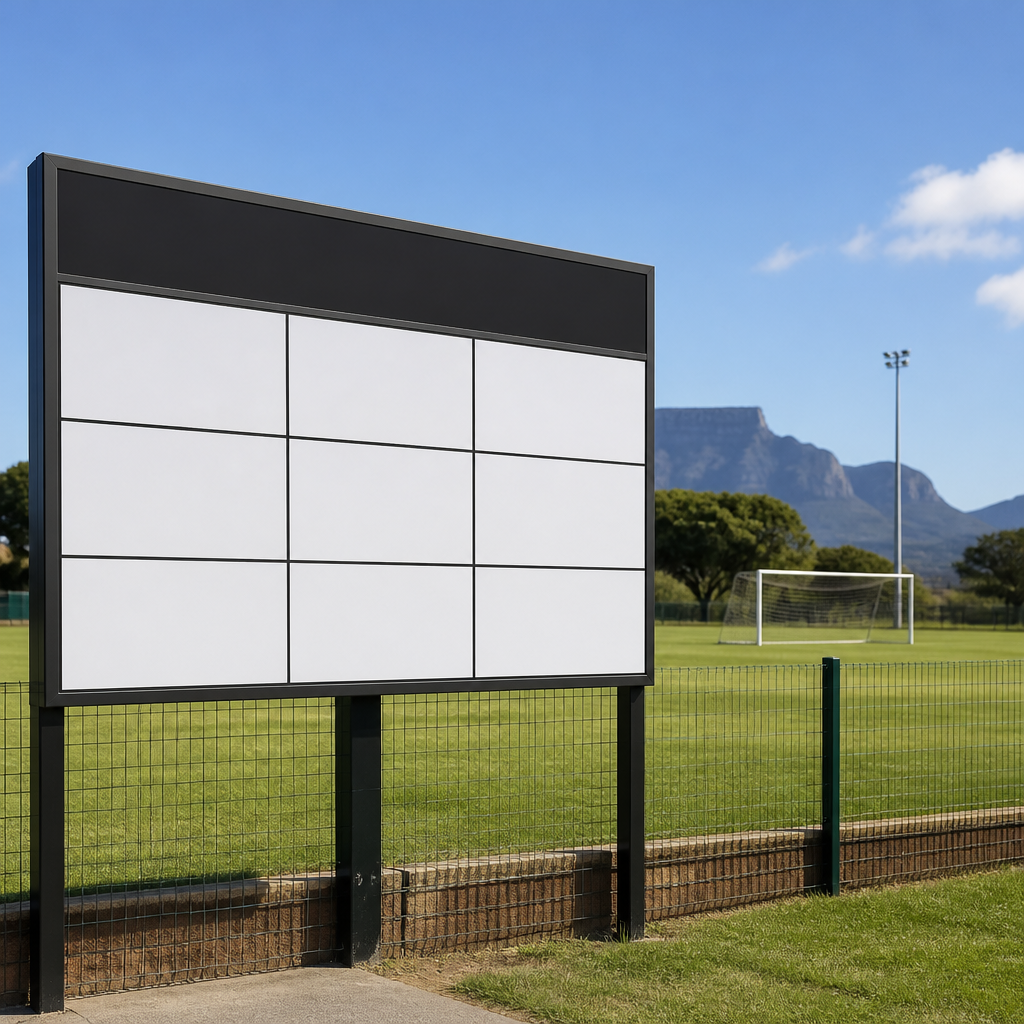
Sell boards by where they are seen. A panel facing the clubhouse terrace, the car park entrance and the main sightline from the stands is worth more than one hidden behind a practice net. Walk the venue with the sponsor and photograph each board from the position a supporter would stand. That photograph does more selling than any rate card.
Build packages around the season
A useful package includes a fixed board for the season, a mention in fixtures or newsletters, and a clear end date. Sponsors who receive a short report with photographs and match dates tend to renew more often than those who receive only an invoice. Keep the report simple: where the board is, how many matches it appeared at, and a current photo.
Public sponsorship policies are also getting more specific. The sponsorship page of Anglo American states that the company does not encourage sponsorship of sport bodies, administration, teams and individuals unless the project is linked directly with community or sport development. Clubs that can show a junior coaching programme or school access have a stronger case with sponsors working under similar rules.
Pro tip: Write the board's exact dimensions, fixing points and removal date into the sponsorship agreement. A board removed without notice ends a relationship faster than a poor season does.
Choosing Sign Types for Each Venue
No single sign type suits every venue. A small community hall with one entrance has different needs from a multi-pitch club with floodlights and a busy car park. The table below compares three approaches we see most often on sports and community sites.
| Sign type | Best for | Watch out for |
|---|---|---|
| Fixed aluminium composite panel with digital print | Gate signs, clubhouse fascia and sponsor boards on walls | Fixings can loosen on palisade fences, and tall panels need proper wind-load fixing |
| Channel lettering with LED illumination | Clubhouse names and main entrances on a building facade | Needs a certified electrical connection, and cost rises with letter size |
| Printed PVC banner on a frame or fence mesh | Tournaments, open days and temporary sponsors | Fades faster than rigid panels in strong sun, and flaps in wind unless properly tensioned |
Permanent versus temporary signage
In practice, we recommend a permanent panel for the gate and clubhouse, and replaceable banners for tournaments. Permanent lettering on the building works well when the club owns the building. It is a poor investment on a leased or shared hall that might change hands, because the lettering stays behind when the tenant leaves.
Avoid mixing materials on one wall. Different panel depths, colours and fixings look untidy within a year, and they make replacement harder because nothing matches when a single panel needs changing.
Maintenance, Rental and Temporary Signage
Signage is the part of a club's infrastructure that committees forget until someone complains. A quick inspection each season prevents most of the callouts we see: loose fixings, faded vinyl, lights that have failed on one side of a sign, and sponsor names that no longer match the current contract.

A seasonal inspection checklist
Walk the site with the sponsorship schedule and the master identity file in hand. Check every fixing, light, edge and panel against the contract. Note each problem, date the note, and assign the repair to a named person. A list with no owner rarely gets done before the first match.
When to rent instead of buy
SignShopper offers signage rental for events, which suits tournaments, festivals and open days where the message changes from one weekend to the next. Renting avoids storage and disposal problems and keeps permanent budget for the signs that stay up year round. A rented banner set can carry the club's identity for a weekend without locking the club into a design that looks dated the following year.
When a permanent sign is due for replacement, keep the old panel's dimensions and fixing points in the master file. The replacement goes up faster, and the sponsor who renews sees the same board in the same position.
Frequently Asked Questions
Do sports clubs need permission to put up signs in South Africa?
It depends on the municipality and the type of sign. The Western Cape by-law and the City of Tshwane guide both separate signs tied to the lawful use of a property from third-party advertising. Ask the local municipality in writing before ordering, especially for illuminated, road-facing or sponsor signs.
How big should a sponsor board be?
Size follows viewing distance, not a standard panel dimension. A board read from the car park needs much larger lettering than one read from the stands. Measure the sightline from where the target audience will stand, then size the logo and text to suit that distance.
Are LED-backlit signs worth it for a community venue?
They are worth it at a main entrance or clubhouse that is used after dark. They are not worth it on a rarely used side gate. Confirm that the building's electrical supply can carry the load, and get a certificate from a qualified electrician before installation.
How should a club price sponsor boards?
Price by visibility and audience rather than panel size alone. Walk the venue, identify the three best positions, and price those higher. Offer a season package with photographs and match dates so the sponsor can see what they bought.
What should a community centre sign include?
Keep it to the centre's name, one line that says what happens inside, and opening or contact information if the venue is open to the public. Use the same colours and typeface as the centre's other materials so that visitors recognise the organisation from the road.
How often should outdoor venue signs be inspected?
Once a season is the minimum for most venues. Check fixings, lighting, edges and content. Sites on exposed ground or near the coast need more frequent checks, because wind and salt air wear fixings faster.
Tell us what your club or venue has learned the hard way about signage, sponsors or permits, because the mistakes we see most often are usually the ones committees have already made once.
References
- Text of the Western Cape outdoor advertising and signage by-law
- National manual for standardising outdoor advertising control criteria
- City of Tshwane guide to displaying advertising signs
- Study on sports sponsorship and corporate financial returns in South Africa
- Corporate sponsorship policy for sport and community projects in South Africa