


School Signage South Africa: Safety, Identity, Wayfinding
When you plan school signage South Africa campuses rely on, you are doing three jobs at once. Signs control who enters, tell people where to go on an ordinary morning or during an emergency, and carry the school's identity to every parent who drives past. Most schools treat signage as an afterthought, bought in a rush after a complaint or a broken gate sign. The result is a campus where visitors circle the block, deliveries stop at the wrong door, and the crest on the gate does not match the one on the letterhead. This guide covers those three jobs in order, with the mistakes we see most often on school projects in Gauteng.
Table of Contents
- Quick Takeaways
- Safety Signage: Gates, Visitors and Emergency Routes
- Identity and Brand Standards for Schools and Campuses
- Wayfinding on Multi-Building Campuses
- Illuminated Versus Static Signage: Choosing the Right Format
- Materials and Maintenance in the Highveld Climate
- Permits, Approvals and Site Considerations
- Planning Your Signage Project for the Next School Year
- Frequently Asked Questions
- References
Quick Takeaways
| Key Insight | Explanation |
|---|---|
| Put visitor directions before the gate | A driver needs to read one clear message while still able to brake comfortably. Place the visitor sign on the road approach, not on the gatepost. |
| Test emergency signs in the dark | Exit and assembly point signs must be readable from the corridor and from the classroom doorway. Check them with the lights off during a drill. |
| Write a brand brief that outlives the principal | Record colour references, crest clear space, approved fonts and allowed sizes. Without it, the next sign order drifts from the school's identity. |
| Repeat wayfinding at every decision point | Place a sign wherever a visitor must choose a direction, including the first junction after the gate and each building cluster. |
| Plan power for illuminated signs | Lit gate signs are worth the cost, but schedule a backup plan for interrupted power and check surge protection at installation. |
| Order term four installs early | Schools that wait until January face rushed installs and signs that go up after new families have already got lost. |
Safety Signage: Gates, Visitors and Emergency Routes
The most expensive signage mistake we see is a visitor who cannot tell, from the road, where to stop. A parent turning in at a school gate should see one clear message: visitor entry, this side, reception. Anything that makes them brake suddenly in the traffic lane or reverse out puts children on the pavement at risk.
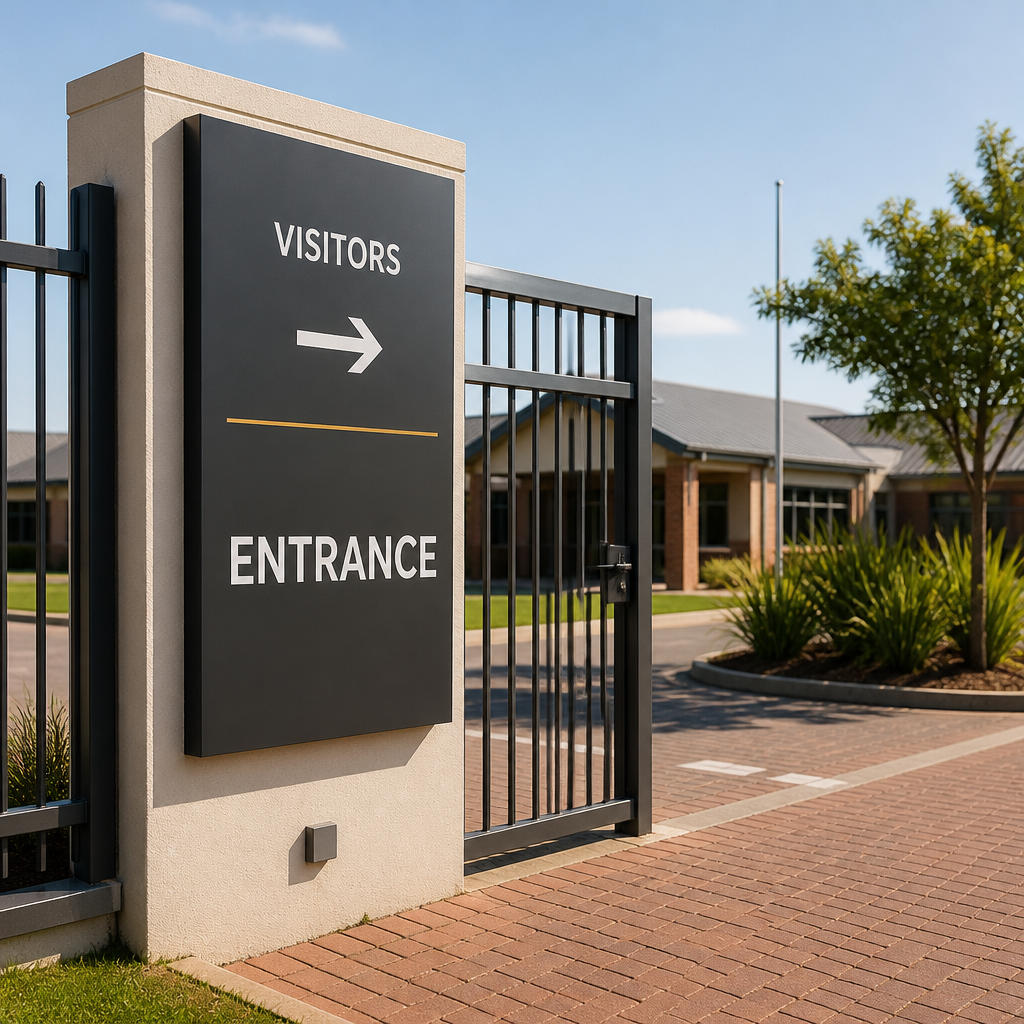
Visitor Entry and Gate Directions
Put the visitor sign on the approach, at the point where a driver can still stop comfortably. A two-line sign with a single directional arrow works far better than a paragraph of rules. Keep the wording short enough to read at a glance, and move any security or sign-in rules to the reception desk where people can actually stop and read them.
Gate signs also need to work at the times when the school is busiest. Morning drop-off and afternoon pick-up are when queues form, so test the sign during those hours rather than on a quiet Saturday site visit.
Emergency Exits and Assembly Points
Exit signage is usually required under building and fire regulations, and it has to stay visible when smoke or a power failure reduces the light. In practice, that means placing signs at eye level in corridors and beside doors, and checking them at night with the building lights off. A common mistake is putting the assembly point sign inside the building, where the people who need it are already outside looking for their class.
Assembly point signs should be posted on the outside walls of each block, with the designated area named clearly. Teachers and support staff should be able to find them without a map. Run a drill and note where staff hesitate, because those points need a sign.
Identity and Brand Standards for Schools and Campuses
A school sign is the one piece of communication that every parent, learner and neighbour sees daily. Yet many campuses have the crest on the letterhead, a different blue on the sports banners and a hand-painted board at the gate. Corporate identity discipline matters here just as much as it does for a franchise network.
Writing a Brand Brief That Survives Turnover
Schools change principals, governing body members and marketing volunteers, often within a few years. The brief should specify exact colour references, the minimum clear space around the crest, approved typefaces and the sizes allowed for each sign type. Without it, the next person ordering a sign will guess, and the guess is usually wrong.
Attach the brief to every quote request. Suppliers who price against a clear brief are easier to compare, and you can reject work that does not match the approved references.
Where Identity Meets Accurate Information
Identity signage also carries information. The school name, office hours, contact numbers and visitor procedures must match across the gate, reception and wayfinding system. A wrong phone number on a gate sign creates more problems than any ugly colour.
Every sign on campus makes a statement about how well the place is run. Parents often read the gate before they read the prospectus.
Pro tip: Photograph every existing sign and compare its colours against the approved palette before you approve a quote. Most mismatches show up in those photos, not in the brief.
Wayfinding on Multi-Building Campuses
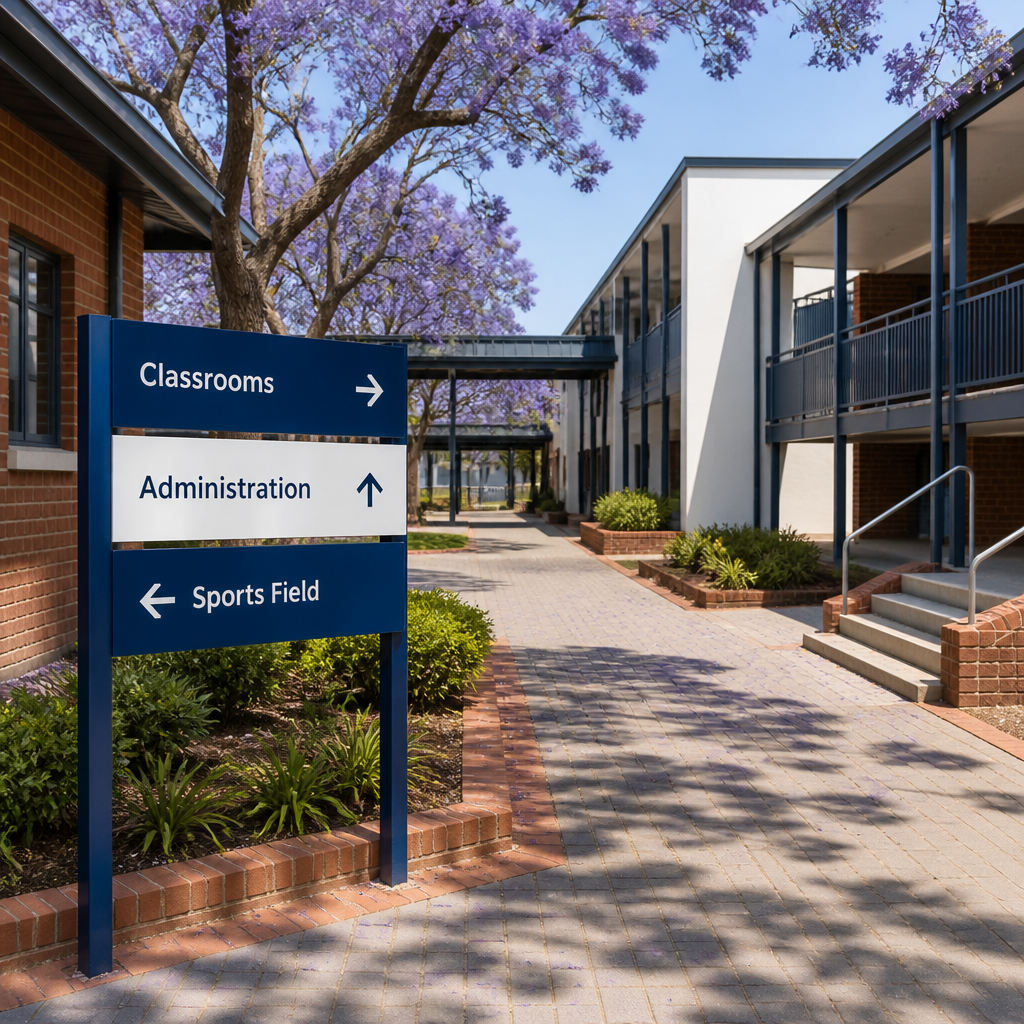
A campus with separate blocks, sports fields and a hall at the back creates a navigation problem that a single noticeboard cannot solve. Visitors arrive with one destination and no mental map. Wayfinding is the system that answers three questions: where am I, where do I go, and how far is it?
Naming and Numbering Buildings
Choose a naming system once and apply it everywhere. Use letters for blocks and numbers for floors, and make sure the same names appear on the site plan, the signs and the website. A building called "Science Block" on one sign and "Block C" on another sends visitors to the wrong door.
Avoid naming buildings after former staff members unless the name also tells a visitor what is inside. Function-based names, such as "Library" or "Grade 3 Classrooms", save time for people who are reading signs while walking.
Decision Points and Sign Spacing
Place a sign wherever a visitor must choose: at the gate, at the first junction, and at the entrance to each building cluster. Long corridors need repetition rather than bigger lettering. Keep each sign to a short list of destinations that a visitor can read while still walking.
Digital directory screens at reception are helpful for some visitors, but they do nothing for the parent standing outside in the sun. Keep printed directional signs as the baseline and treat screens as an extra layer.
Pro tip: Walk the route yourself with a parent who has never visited the campus, and note every point where you hesitate. Those are the spots that need a sign.
Illuminated Versus Static Signage: Choosing the Right Format
Schools rarely need one sign format everywhere. The right choice depends on where the sign sits, when people read it, and who will maintain it after installation. Mixing formats deliberately usually produces a better campus than choosing one type for the whole site.
| Signage Type | Best Use on a School Campus | Main Trade-Off |
|---|---|---|
| Printed or static panels | Internal wayfinding, room numbers, class names and notices inside buildings | Needs daylight to be read, and graphics fade in strong sun, so replacement is part of the budget |
| Illuminated LED-backlit or channel lettering | Main gate, school name at the entrance and reception signage that must be readable at night | Needs a reliable power supply and a plan for outages, with higher installation cost |
| Digital display screens | Event notices, daily announcements and visitor information at reception | Requires ongoing content management, dust and heat protection, and a technician when screens fail |
In practice, we recommend illuminated signs only where night visibility matters, which usually means the gate and the main entrance. Interior wayfinding is better served by well-designed static panels that are cheap to replace. This split keeps capital costs under control and still delivers the visibility where it counts.
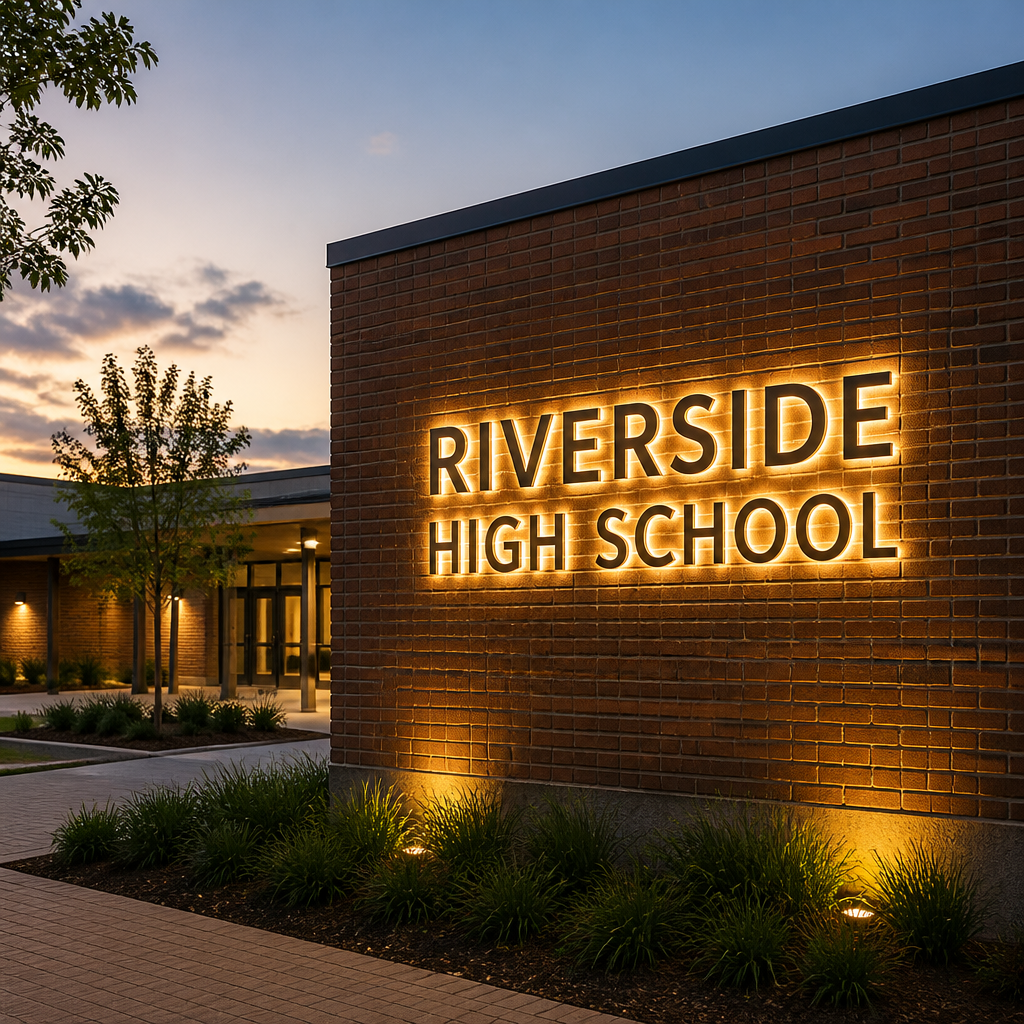
Where Illumination Pays Off
Illumination is worth the investment when a sign has to guide people after dark, such as evening events, parent meetings or sports fixtures. A lit gate sign also signals that the school is open and staffed, which matters for visitors arriving at unfamiliar hours. Keep the lit area small and focused to limit energy use.
Where Digital Screens Go Wrong
Screens fail most often because nobody owns the content. A reception screen with last year's event still running sends a worse message than no screen at all. If you install digital displays, assign one staff member to update them weekly and set a fallback message for when the system is offline.
Materials and Maintenance in the Highveld Climate
Gauteng is hard on outdoor signage. Summer brings strong UV, afternoon heat and storms that can carry hail, while the dry winter months bring dust from building sites and roads. Materials that look fine on a quote can fade or warp within a few years if they were not specified for these conditions.
Substrates, Vinyl and Frames
Specify UV-stable print films and protective laminates for any outdoor board, and avoid cheap vinyl on sun-facing surfaces. Powder-coated or galvanised metal frames hold up far better than untreated steel. Ask for the warranty in writing and check exactly what it covers, especially fading and delamination.
Sun-facing boards fade first. If a gate sign faces west, expect to replace the graphics sooner than a sign on the north side of a building, and budget for that from the start.
Lighting Maintenance and Power Interruptions
LED-backlit signs are efficient, but they still need periodic checks. Ask the installer how the sign is powered, whether it has surge protection, and what happens during a power cut. A timer that switches illumination off at a fixed time saves energy, but the main value is keeping the gate lit during the hours that matter.
Consider a small backup, such as a battery or a simple guard sign, for critical signs at the gate. A dark gate during a power failure is precisely when a visitor needs direction most.
A Simple Maintenance Calendar
Schedule a walk-around at the start and end of each term. Check for loose panels, cracked lenses, faded graphics and failed lamps. Record the findings in writing so the next service visit fixes the list rather than rediscovering the same faults.
Pro tip: Ask for a sample of the exact vinyl and laminate before you approve the job, and leave one panel in direct sun for a few weeks if the sign is critical. You will learn more from that test than from any brochure.
Permits, Approvals and Site Considerations
Many schools assume signage is their own business. In practice, larger, illuminated or freestanding signs often need municipal approval, and the rules differ between municipalities. Start the conversation before you order, not after the sign is already up.
Checking Municipal Requirements
Contact your local municipality's building or outdoor advertising department and ask whether the sign needs an application. Check setback lines from the road, height limits and any restrictions on illumination near residential properties. Share these limits with your installer at the quoting stage so the design is approved the first time.
Structural and Electrical Checks
Freestanding pylon or post signs must be designed for wind loading, and their foundations must suit the soil on site. Electrical work should be carried out by a qualified person, and the installer should provide the compliance documents the municipality or your insurer requests. Ask to see these before final payment.
Protecting Learners During Installation
Install during school holidays wherever possible, and fence off work areas before the crew arrives. Never leave ladders, cables or loose materials where learners can reach them during the day. Ask the installer for their written site safety plan and confirm who on the school side is responsible for supervising the site.
Planning Your Signage Project for the Next School Year
October is when decisions for the next school year should be made, not the first week of January. Term four is busy with exams and events, so start by agreeing on the budget and the approval chain now. Late orders usually mean rushed installs and signs that go up after the first new families have already got lost.
Building a Phased Plan
Start with gate, reception and emergency signage, because these carry the most safety risk. Move to campus wayfinding and building names in the second phase, then refresh banners, sports field boards and event displays in the third. Phasing spreads the cost and lets you test the wayfinding before you commit to every building.
Getting Quotes That Compare
Ask every supplier to quote against the same drawings, sizes, materials and installation scope. A low price often excludes permits, electrical work or removal of the old signs. Request a site visit and a written installation schedule before you sign.
Treat the quote as a checklist. If one supplier includes removal and making good, and another does not, the cheaper quote is not cheaper at all.
Frequently Asked Questions
What should a school gate sign say in South Africa?
A gate sign should tell visitors exactly where to go in as few words as possible, usually with the words visitor entry or reception and a directional arrow. Keep security or sign-in rules off the gate and place them at the reception desk where people can read them without holding up traffic.
How long does school signage last outdoors?
Lifespan depends on the materials. Well-specified UV-stable print and powder-coated or galvanised frames can last for several years in Gauteng conditions, while cheap vinyl on sun-facing boards often fades much sooner. Check the warranty wording on fading before you accept a quote.
Do school signs need municipal approval?
Often yes, particularly for illuminated, large or freestanding signs. Rules vary between municipalities, so contact the local building or outdoor advertising office before you order and share the approval outcome with your installer.
Is digital signage better than printed signs for a campus?
Digital screens are not a replacement for printed directional signs. Use printed signs for permanent wayfinding and screens for changing information like events and announcements, and make sure someone owns the content.
When should a school order new signage?
Plan during term four so that gate and emergency signs are installed before the new school year starts. Late orders often lead to rushed installation and signs that are not checked properly.
What signage problem has your school or campus faced most often, and how did you solve it?