


Banners and Flags South Africa: Which Format Wins?
Most South African businesses pick a banner or flag format because they saw a competitor using it, or because it was the cheapest option on the printer's homepage. That is a poor way to spend a branding budget. Banners and flags in South Africa cover a wide spectrum of formats, materials, and use cases, and the wrong choice does not just look bad - it fails to do the job entirely. A teardrop flag outside a busy Gauteng forecourt and a fabric pull-up banner inside a hotel conference room serve completely different purposes, and treating them as interchangeable is where brands lose visibility and money. This guide breaks down every major format, matches each one to a specific business goal, and tells you exactly when to use what.
Table of Contents
- Quick Takeaways
- Understanding the Banner and Flag Landscape in South Africa
- Outdoor Formats That Earn Their Keep
- Indoor Formats for Controlled Environments
- Material Matters: PVC, Fabric, and Mesh Compared
- Corporate and Franchise Signage: Specific Needs
- Format Comparison: Choosing the Right Option
- Common Mistakes Businesses Make When Ordering Banners and Flags
- Frequently Asked Questions
- References
Quick Takeaways
| Key Insight | Explanation |
|---|---|
| Feather and teardrop flags outperform static outdoor banners in high-wind conditions | Their curved shapes allow wind to flow around the fabric, reducing drag and keeping the message visible rather than twisted or torn. |
| PVC banners are the most cost-effective choice for short outdoor campaigns | Durable for weeks to months outdoors, easy to replace, and cheap enough to refresh messaging per promotion cycle without remorse. |
| Pull-up (roller) banners belong indoors, not at roadside events | Their lightweight frames and single-pole design are not engineered for wind exposure. Using them outdoors risks damage and poor visibility. |
| Double-sided flags double your impressions without doubling your footprint | Roadside and forecourt placements benefit enormously from flags printed on both sides, capturing traffic from both directions. |
| Franchise and corporate clients need CI-compliant print tolerances | Colour consistency across a fleet of banners or flags matters for brand integrity. Dye-sublimation on polyester delivers more consistent results across print runs than solvent printing on PVC. |
| Mesh banners are the correct choice for large outdoor spans exposed to wind | The perforated surface lets wind pass through, making mesh the standard for building wraps, scaffolding, and large roadside frames in Gauteng's notorious afternoon storms. |
| Rental signage solutions reduce capital cost for short-duration events | For events lasting days or weeks, renting banner and flag hardware rather than purchasing avoids depreciation costs and storage overhead. |
Understanding the Banner and Flag Landscape in South Africa
The term "promotional banners Gauteng" gets used as if it covers one product. In practice it covers at least a dozen distinct formats, each with a different engineering rationale. Businesses operating in South Africa face specific environmental challenges - intense UV exposure, frequent afternoon thunderstorms in Gauteng, and the need for branding that reads clearly at distance from a moving vehicle. Those conditions eliminate certain formats immediately and make others the obvious professional choice.
The core distinction to make first is indoor versus outdoor. Outdoor signage must contend with UV degradation, wind loading, and rain. Indoor signage prioritises print quality, portability, and a polished finish. A format that excels in one environment is typically the wrong choice in the other. Getting this decision right before you brief a printer saves you the cost of reprinting.
The second distinction is temporary versus semi-permanent. Promotional campaigns, activations, and events call for formats that are fast to set up, easy to move, and inexpensive to replace. Permanent or semi-permanent applications, such as a franchise entry sign or a corporate reception backdrop, justify higher material investment and more precise installation. South African businesses that mix these categories end up with either over-engineered event props or under-specified permanent signage.
A banner that survives one Highveld afternoon storm is worth more than a beautifully printed one that shreds by Tuesday. Specify your environment before you specify your format.
Outdoor Formats That Earn Their Keep
Feather Flags and Teardrop Banners
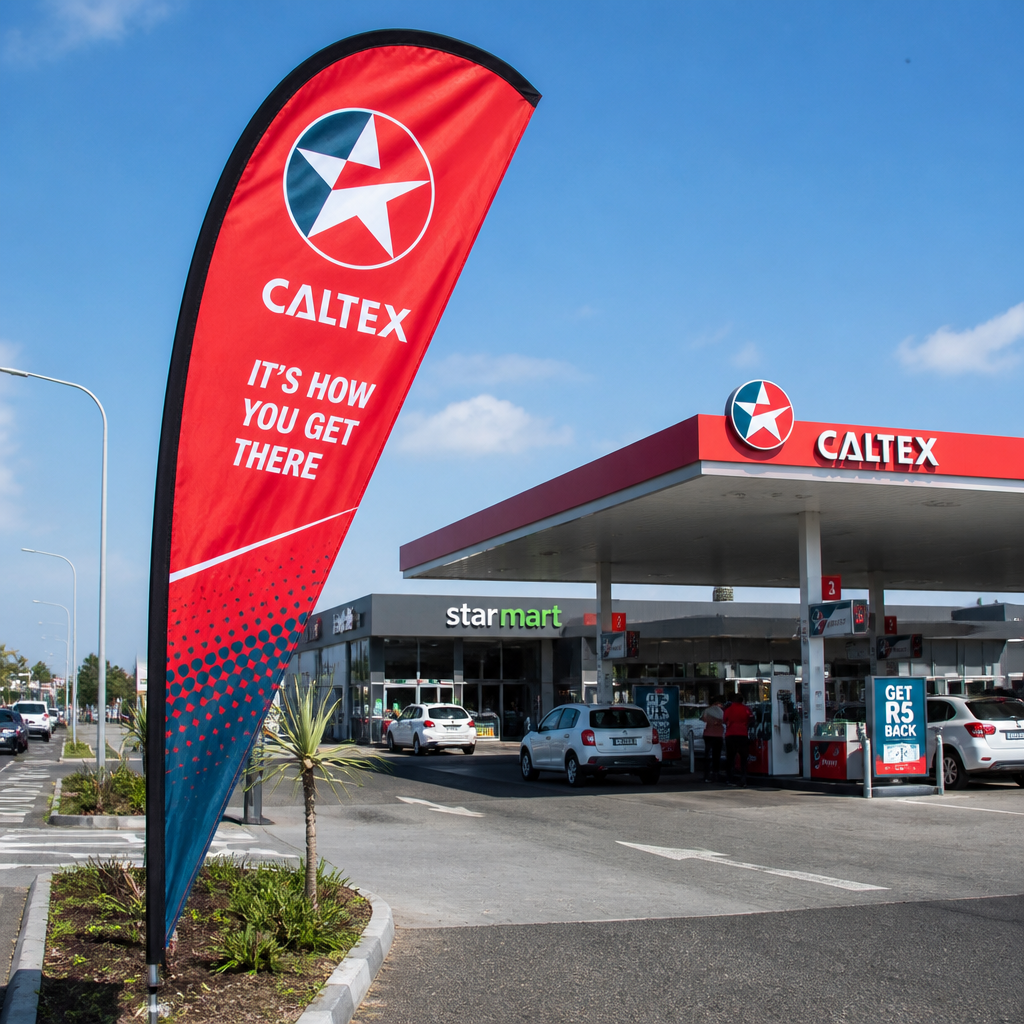
Feather flags and teardrop banners are the dominant outdoor promotional format for retail forecourts, restaurant entrances, and event perimeters across Gauteng. The teardrop shape is specifically engineered so that wind flows around the fabric rather than fighting it, which reduces mechanical stress on the pole system and keeps the printed face visible. Available in heights typically ranging from 2m to 4m, these flags are supplied with a pole system, ground spike, and carry bag, making setup a one-person job in under three minutes.
For businesses running roadside activations, double-sided feather flags are the professional standard. Two separate pieces of fabric with a block-out liner between them prevent bleed-through and ensure the message reads clearly to traffic approaching from either direction. Single-sided flags are cheaper but cut impression reach in half on two-way roads.
Pro tip: If your forecourt or activation point faces a road with traffic moving in both directions, always specify double-sided print. The cost difference is marginal; the impression difference is significant.
Street Pole Flags
Street pole flags serve a different purpose from feather flags. Where feather flags are freestanding event and forecourt tools, street pole flags are fixed to lamp posts or dedicated poles along a road or within a shopping precinct. They are a standard format for franchise retail parks, hotel entrance roads, and municipal event branding in South Africa.
Because they are semi-permanently mounted, street pole flags need to be produced on durable fabric with UV-stable inks and reinforced hems. A poorly hemmed street pole flag will unravel within weeks in Gauteng's wind. Specify double-stitched hems and UV-resistant dye-sublimation print as a minimum for any street pole application that will remain up longer than a single event cycle.
PVC and Mesh Banners for Large Outdoor Spans
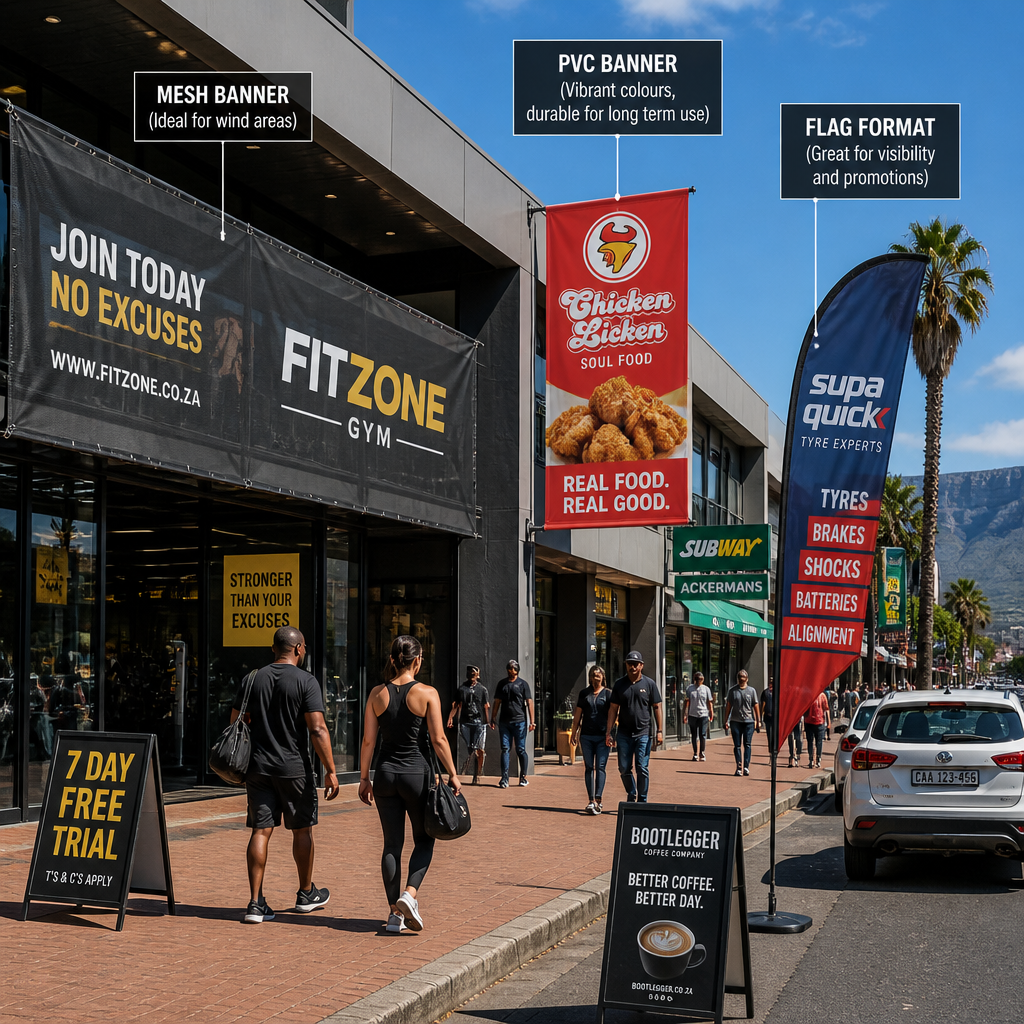
For large horizontal or vertical outdoor spans - building wraps, scaffolding covers, perimeter fencing at events, or roadside frames - PVC and mesh are the two practical choices. Standard PVC is solid, takes solvent or UV-cured inks well, and is affordable for short to medium-term campaigns. However, in a large unsupported span exposed to wind, solid PVC acts like a sail. That is where mesh becomes the correct specification.
Mesh banners have a perforated surface that allows wind to pass through, dramatically reducing load on fixings and frames. This makes mesh the professional choice for any outdoor banner wider than roughly 3 metres that is mounted on a structure rather than enclosed in a rigid frame. The visual quality is slightly lower than solid PVC at close range, but from roadside viewing distances the difference is negligible and the structural advantage is substantial.
Indoor Formats for Controlled Environments
Pull-Up and Roller Banners
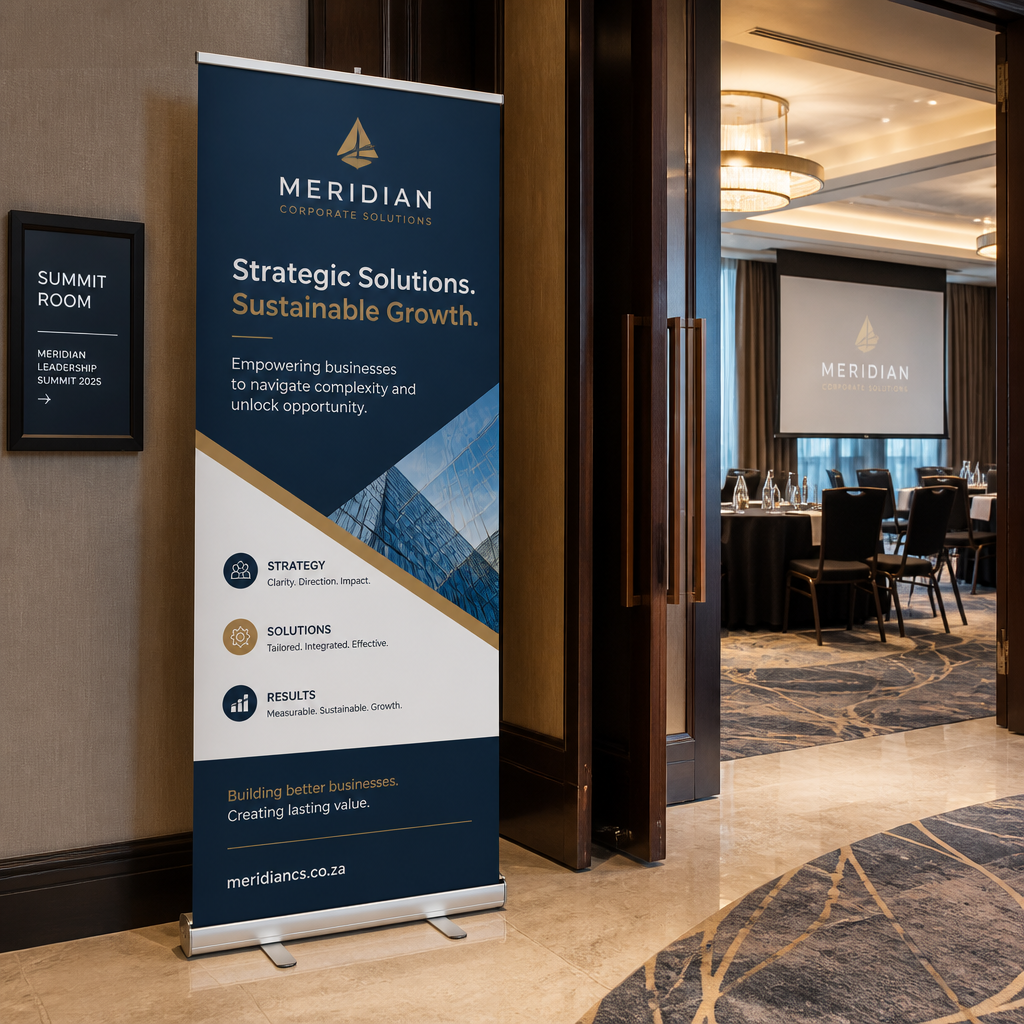
Pull-up banners, also called roller banners or retractable banners, are the standard indoor display tool for exhibitions, conferences, hotel lobbies, retail interiors, and gym reception areas. The mechanism is simple: the printed graphic rolls up into a base cassette for transport and deploys in under thirty seconds with a single support pole. For businesses that attend multiple events per year, a well-specified pull-up banner pays for itself across deployments.
The common mistake is ordering the cheapest base unit available. Budget base cassettes have weak spring mechanisms that lose tension after a few uses, leaving the banner partially retracted and visually sloppy. For corporate clients, specifying a mid-to-premium cassette mechanism with a wider base foot for stability is a better long-term decision. The base matters as much as the print.
X-Banners and A-Frame Banners
X-banners use a lightweight cross-frame and are the most affordable indoor display format. They are well-suited to high-turnover messaging - price promotions, menu specials, directional signage inside a venue - where the print needs replacing frequently and cost-per-use matters more than premium finish. A-frame banners (sometimes called pavement signs) occupy the intersection between indoor and outdoor use, typically positioned at a shopfront entrance or restaurant door, and are a reliable short-range traffic driver.
Neither format is a substitute for a pull-up banner at a formal event or exhibition. They occupy a different tier of the indoor signage toolkit: practical, fast, and inexpensive rather than polished and brand-forward.
Fabric Backdrops and Banner Walls
For corporate events, product launches, hotel ballrooms, and media backdrops, fabric banner walls are the premium indoor format. Printed on stretch fabric using dye-sublimation, they sit flush against a pop-up frame with no wrinkles, no visible joins, and no light-bleed from back-lighting. The result looks significantly more professional than a printed vinyl backdrop at the same size.
These are a direct expression of corporate identity standards. For a franchise brand running a national launch event in multiple cities, fabric banner walls ensure that every venue looks identical in photography and video. That consistency is something that is very difficult to achieve with PVC print across multiple print runs.
Pro tip: For any event where photography or media coverage is expected, specify dye-sublimated fabric for your backdrop. PVC prints show glare under camera flashes and event lighting. Fabric does not.
Material Matters: PVC, Fabric, and Mesh Compared
The material choice for any banner or flag determines its lifespan, its visual quality, its wind performance, and its suitability for the environment. There is no single best material. There is only the right material for each specific application. For business flag printing in South Africa specifically, the three dominant material categories are PVC (vinyl), polyester fabric, and mesh.
PVC banners are printed using solvent or UV-cured inks and are waterproof, relatively UV-stable, and robust enough for outdoor use over weeks to months. They are the default for short-term outdoor promotions, events, and construction site signage because they are inexpensive to produce and easy to replace. The trade-off is visual: at close range, PVC prints have a slightly plasticky finish, and in large unsupported spans they flex and sag in wind.
Polyester fabric flags and banners are printed using dye-sublimation, which embeds pigment into the fibre rather than sitting on the surface. This produces more vibrant colours, better UV resistance for flags that move constantly in wind, and a more premium visual finish. Fabric is the correct choice for feather flags, street pole flags, fabric backdrops, and any application where the product will be used repeatedly over months or years.
Mesh occupies the specific niche of large outdoor installations exposed to wind. It is the appropriate specification for building wraps, perimeter fencing, and large scaffold covers. Its visual quality is lower than PVC at close range but its structural performance in exposed outdoor conditions is superior.
Corporate and Franchise Signage: Specific Needs
Corporate and franchise clients have requirements that individual businesses and event organisers do not face to the same degree. The primary one is Corporate Identity (CI) compliance. When a franchise deploys banners and flags across fifty locations in Gauteng and beyond, every unit must match. Colour deviations that look minor on screen become obvious when thirty flags are lined up at a national event or installed along a franchise retail park entrance road.
This is where the choice of print technology and supplier becomes a business-critical decision rather than a cost-centre one. Dye-sublimation printing on polyester fabric is more consistent across large runs than solvent printing on PVC, because the ink integration is more stable and less subject to batch variation. For high-volume franchise flag orders, specifying dye-sublimation and requesting colour proofs against your brand's Pantone reference is standard professional practice.
The second corporate-specific consideration is rental versus purchase. For events, activations, and short-duration campaigns, renting banner and flag hardware rather than purchasing eliminates the depreciation, storage, and logistics overhead of owning a large signage fleet. Rental solutions are especially practical for brands that run regional activations across South Africa and do not want to transport heavy hardware between provinces. SignShopper provides rental solutions for signage needs across South Africa and into Africa, which is a practical option for corporate marketing teams managing event calendars across multiple locations.
Franchise owners should also consider that banner and flag signage does not exist in isolation. It is part of a broader signage system that includes pylon signs, channel lettering, and LED-backlit elements at a retail or hospitality location. The banner and flag component should be briefed with the full site signage plan in mind, so that formats, heights, and colours integrate with the permanent signage rather than competing with it visually.
Format Comparison: Choosing the Right Option
| Format | Best Use Case | Key Limitation |
|---|---|---|
| Feather / Teardrop Flag | Outdoor forecourts, event perimeters, roadside activations, retail entrances. Handles wind well due to curved shape. Ideal for Gauteng's weather conditions. | Limited print area compared to flat banners. Message must be concise. Not suited to fine-detail photography or complex graphics. |
| PVC Banner (flat) | Short-term outdoor promotions, construction hoardings, event perimeter walls, street-level messaging. Cost-effective and replaceable. | Becomes a liability in large unsupported spans exposed to strong wind. Not suitable for building wraps without mesh specification. Shorter lifespan than fabric. |
| Fabric Pull-Up Banner | Exhibitions, conferences, hotel lobbies, gym interiors, retail point-of-sale. Professional finish, portable, fast setup and breakdown. | Indoor use only. Wind exposure damages the lightweight frame. Not designed for outdoor deployment under any circumstances. |
| Mesh Banner | Large outdoor spans on buildings, scaffolding, perimeter fencing at outdoor events. Wind passes through, reducing structural load on fixings. | Lower print resolution at close range compared to solid PVC or fabric. Not appropriate for indoor or close-up viewing contexts. |
| Street Pole Flag | Franchise retail parks, hotel entrance roads, shopping centre corridors, event precinct branding. Semi-permanent placement, high repeat-exposure to passing traffic. | Requires fixed mounting infrastructure. Not a portable or event-specific solution. Higher production standard required for semi-permanent use. |
| Fabric Banner Wall | Corporate events, product launches, media backdrops, hotel ballrooms. Premium finish, no glare under lighting or photography. | Higher cost than PVC. Requires a compatible pop-up frame. Not suited to outdoor deployment. |
Common Mistakes Businesses Make When Ordering Banners and Flags
The most expensive mistake in business flag printing and banner procurement is specifying the wrong format for the environment. An indoor pull-up banner deployed outdoors at an activation will be damaged within hours in typical Gauteng afternoon wind. A solid PVC banner mounted in a large unsupported outdoor frame will act as a wind sail and either tear or pull its fixings out of the wall. These are not hypothetical risks; they are common outcomes when the brief does not specify the environment clearly.
The second common mistake is under-specifying on CI-critical projects. Ordering the cheapest available flag for a franchise rollout and discovering that the colours do not match your brand standards across the fleet is an expensive problem to fix. A single colour proof or strike-off before committing to a large run costs a fraction of a reprint.
A third mistake specific to events is ordering too late. Standard production lead times for banner and flag printing in South Africa typically run from three to seven working days after artwork approval, depending on specification and volume. Urgent production may be available, but it commands a premium and reduces your options for quality checking. Building at least ten working days into your event timeline between artwork sign-off and installation date eliminates the need for rushed production.
Finally, many businesses treat banners and flags as one-off purchases and ignore replacement planning. Outdoor flags in particular are consumable items. UV exposure and wind stress degrade fabric and fade print over time. A semi-annual replacement budget for outdoor flags and promotional banners is more professional practice than running visibly faded or torn signage because the budget cycle does not accommodate replacements. Visit SignShopper's signage products page to explore the full range of banner and flag formats available for South African corporate and franchise clients.
Frequently Asked Questions
What is the difference between a feather flag and a teardrop banner?
Both are freestanding outdoor flag formats on flexible poles with ground spikes, but their shape differs. A feather flag has a tapered top that curves like a feather, allowing the fabric to wave freely in wind. A teardrop banner has a taut, teardrop-curved shape that keeps the print face stretched and more static, making it easier to read in variable wind. Teardrop banners are generally better for legibility; feather flags create more visual movement and work well for drawing attention from a distance.
Which banner material is best for outdoor use in Gauteng?
For flags and smaller outdoor formats, dye-sublimated polyester fabric is the best choice because it handles UV exposure and constant wind movement without cracking or peeling. For flat outdoor banners at short-to-medium duration, PVC is cost-effective and weatherproof. For large spans on buildings or perimeter fencing, mesh PVC is the correct specification because it allows wind to pass through and reduces the load on the mounting structure.
Can pull-up banners be used outdoors at events?
No. Pull-up banners are engineered exclusively for indoor use. Their lightweight aluminium or plastic frames and single-pole construction provide no resistance to wind. Using them outdoors risks damage to the mechanism, the print, and potentially nearby people or property. If you need a portable display format for an outdoor activation, specify a weighted-base feather flag or teardrop banner with a ground spike system instead.
How important is double-sided printing for outdoor flags?
For any flag positioned where traffic or foot traffic approaches from both directions, double-sided print is important. A single-sided flag delivers one impression per passing audience member. A double-sided flag delivers two. The cost difference between single and double-sided is typically a fraction of the overall flag cost, making it the logical specification for roadside, forecourt, and event perimeter placements. Single-sided is only the better choice when the flag will consistently face one direction, such as against a wall or at a single-entry point.
How do I maintain consistent branding across a large franchise banner and flag rollout?
Specify dye-sublimation printing on polyester fabric for flag formats, as this technology delivers more consistent colour reproduction across large print runs than solvent printing on PVC. Provide your printer with precise colour references, ideally a Pantone specification, and request a physical proof before committing to the full production run. Work with a signage provider that has direct experience in franchise and corporate CI compliance, as the production tolerances and quality-checking process differ from standard event print work.
What lead time should I allow for banner and flag production in South Africa?
Standard production lead times after artwork approval typically run three to seven working days, depending on the specification, quantity, and current production schedule. For large orders, CI-specific work, or special materials like double-sided fabric flags, allow at least five to seven working days from artwork approval. Factor in delivery time on top of production, especially for locations outside Gauteng. Building ten working days of total lead time into your event or campaign timeline eliminates the need for rush fees and reduces the risk of arriving with substandard or incomplete signage.
Is it better to buy or rent banner and flag hardware for events?
For one-off or infrequent events, rental is almost always the better financial decision. Purchasing hardware that sits in storage between events accumulates depreciation cost, storage cost, and the risk of obsolescence as formats change. Rental makes sense for businesses running regular high-volume event calendars where owning a fleet of hardware reaches breakeven quickly. For corporate clients managing activations across multiple South African provinces or into neighbouring countries, rental solutions eliminate the logistics cost of transporting hardware between locations.
Have you recently navigated a banner or flag format decision for a South African event or retail location? Share what worked and what you would do differently - your experience helps other business owners make better choices.
References
- Roll-up banner uses explained for South African businesses, including event and exhibition guidance
- Flag banner specifications, materials, and outdoor use guidance for South African promotions
- Overview of flag and banner types available in Johannesburg and Gauteng, including feather flags and PVC banners
- Technical detail on wind-resistant outdoor flags and double-sided beach flag production in South Africa
- Vinyl versus fabric banner comparison covering durability, environment suitability, and use case differences